














Cross-country ski pants: fit guide and breathability
When looking for cross-country ski pants, the most common mistake is to reason as for alpine skiing: warmer, heavier, more protective. In the bottom the body produces heat quickly, the intensity changes often and internal moisture becomes the first enemy of comfort. The right choice comes from two criteria: fit and breath. This guide is designed for those who alternate beaten slopes, regular workouts, tourist exits and cold days without wanting to buy a garment too technical or too generic.
In summary
- Choose a tight or athletic fit if you do skating, backed workouts or want maximum freedom of movement.
- Prefer a lightweight softshell trousers if you look for comfort, wind protection and versatility.
- The padding rarely serves: in the bottom it counts more to evacuate the sweat that retains heat.
- Always try the pants with the layer base that you will really use, bending knees and also.
- If your use is closer to skins and descent, oriented on different criteria: here you find a guide dedicated toski touring trousers.
Because the bottom trousers are different from the alpine ski pants
Cross-country skiing is an aerobic sport. Even with rigid temperatures, after a few minutes the body generates heat, especially uphill, in skating and in sessions at a high average pace. Too hot pants may seem comfortable at the start, but it quickly becomes damp inside.
The result is predictable: first it sweats, then it cools in breaks or slower traits. For this reason the bottom pants work on a finer balance than the track pants. They must protect in front, breathe behind, accompany the step and not create useless volume around knees and ankles.
The correct question is not how hot it keeps. It's as dry as you move.
Fit: how much they have to adhere
The fit in the bottom is not only an aesthetic question. It affects the mechanics of the gesture, the dispersion of the moisture and the comfort when alternating pushes, bends and recovers. Too wide trousers can create friction, hold cold air or move badly over the boot. Too tight trousers can limit the hip extension and cause discomfort in life.
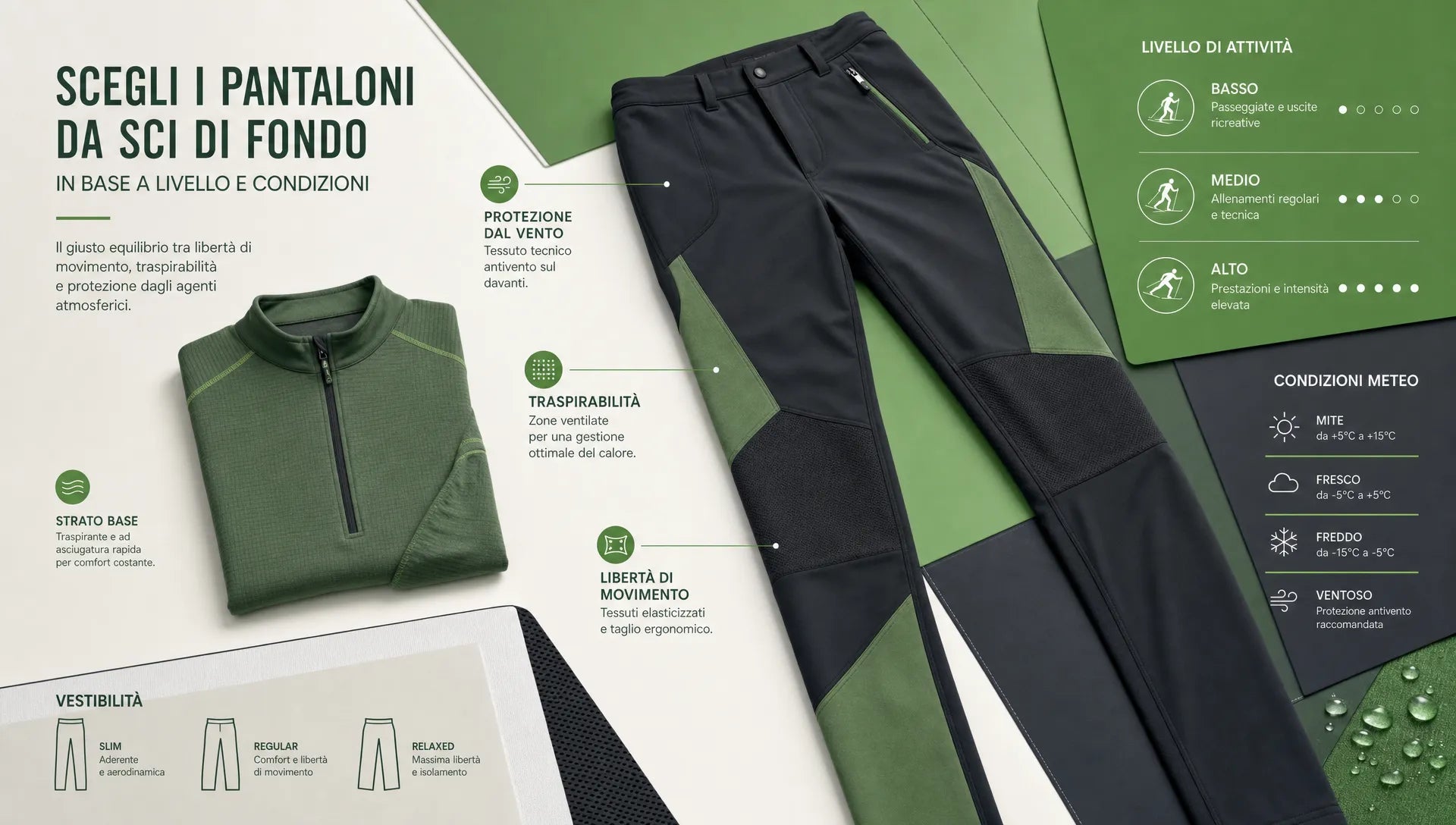
For the advanced beginner and for those who make tourist exits, the athletic fit is often the most balanced choice: quite close to the body not to interfere, but not exasperated. Those who train with continuity or practice skating tends instead to prefer technical tights or pants very adherent, because they better follow the falcade and dry faster.
| Type of fit | Feeling on me | Ideal for | To be evaluated |
|---|---|---|---|
| Technical Tight | Very close to the body | Training, skating, sustained rhythm | Requires a good layer base on cold days |
| Athletics | Adherent but not compressed | Regular use, classic, sports tourism | He must leave freedom to knee and anca |
| Regular technical | More convenient, with controlled volume | Quiet, cold, beginners | You should not fly or make folds on the boot |
| Lightweight superpantalone | To wear on a tight | Pre-race, breaks, travel, cold variable | It must be easy to remove and store |
A good test in the dressing room is simple: fold your knees, simulate a side push and make a light drowning. If the trousers pull in, lock the thigh or slide down, it is not the right fit.
Breathing: the criterion that decides comfort
Breathing is the ability of the head to let out the steam produced by the body. In the background it is decisive because the movement is continuous and breaks are often short. A fabric can be warm and protective, but if it does not handle moisture well it becomes uncomfortable in less than an hour.
Technical trousers often meet two constructive logics. The first is the elastic and light fabric, thought to quickly download sweat. The second is hybrid construction, with more protection in areas exposed to the wind and more breathability where the body produces heat.
The thigh front deserves attention: it is the part that takes more air forward. The rear part, instead, should favor movement and drying. For this reason many trousers are not uniform in behavior: they protect where they serve, breathe where the heat accumulates.
A practical choice:
- If you sweat a lot, it prefers elastic and light fabrics, with fit close to the body.
- If you go out often with wind, look for a more protective construction on the front.
- If you make slow tourism or accompany the family, consider a light softshell more comfortable.
- If you stop often, work with layering instead of choosing a very padded pants.
Choose based on rhythm, weather and real use
The correct pant is not universal. It depends on how much you push, how cold you find and how long you stand between one and the other. Those who do an intense hour after work have different needs from those who spend half a day on easy slopes with frequent breaks.
| Main Use | Priority | Recommended Fit | Layering under |
|---|---|---|---|
| Intense training | Breathing and mobility | Tight or athletics | Light layer base, if necessary |
| Tourist exit | Comfort and cold management | Athletic or regular technical | Light or medium layer base |
| Windy day | Front protection | Hybrid or softshell light | Breathable layer base |
| Slow rhythm with breaks | Managed heat | Softshell light | Base layer medium |
| Travel and mixed use | Versatility | Regular technician clean | Modular layering |
Those who practice skating tend to warm a lot, even with low temperatures. Those who do classic at a relaxed pace may need an extra protection wire, especially if the track is exposed or if you alternate active stretches and stops.

Layering: what to wear under
The bottom pant works well only if the first layer is consistent. Cotton is not indicated because it absorbs moisture and dries slowly. Better a technical, light or medium layer base depending on intensity and temperature.
For short and dynamic workouts a first light layer can be enough under a tight or athletic pants. For slower exits, dry cold or days with stops, a medium layer base under a light softshell offers more comfort without turning the pants into a lead.
Attention also to the ankle area. The bottom requires freedom around the boot, so the bottom leg must remain ordered, without excessive volume. If the trousers interfere with the stocking or creates rigid folds, at the long time it becomes annoying.
Quick guide to size
The size should be chosen on the movement, not only on the rest measure. Life and basin must be stable, but without compressing breathing. The thigh must be able to work in extension and bending. The knee should not pull when you lower.
If you're in two sizes, ask yourself first how you'll use your pants. For exercise and high rhythm, a fit closer to the body is often better, provided you do not limit the gesture. For tourism, cold and mixed use, a slightly more comfortable size can leave space to a medium layer base.
Three useful controls before purchase:
- Life stays in place when you simulate a push.
- The fabric does not pull on knee, horse or back thigh.
- The bottom leg rests well on the boot without accumulating volume.
Our recommended selection
In the Fabbrica Ski Sises selection it is advisable to start from use: intensity, protection and versatility. For high-speed garments look at the Sportful proposal, for a more transversal Nordic wardrobe you can orientate onRossignolWhileSalomonis a good direction for those looking for technical clothing and coordinated outdoor accessories.


Tight technical background
Ideal for:Regular workouts, skating, short and intense sessions.
Key Features:fit close to the body, elastic fabric, good moisture management and little moving mass. It is the cleanest choice if your goal is to ski with rhythm and not feel the pants.
To match:light layer base on cold days, breathable bottom jacket and technical gloves. If you leave early or stop after training, add a warm garment to wear immediately off the track.
Softshell trousers light
Ideal for:tourist exits, classic at medium rhythm, cold but not extreme days.
Key Features:more protection than a tight, less specialized fit and superior comfort for those who do not want too tight. It works well when the intensity changes during the day.
To match:light or medium layer base, softshell jacket or technical vest. It is a balanced solution for those who want only one trousers for more winter uses.
Hybrid trousers with front protection
Ideal for:exposed slopes, wind, workouts where alternate intense traits and recovery strokes.
Key Features:greater front barrier and better heat evacuation in less exposed areas. It is a rational choice for those who suffer the wind but do not want to give up the breath.
To match:first dry technical layer and light jacket. Avoid loading too much the bust if the rhythm is sustained: the system must breathe as a whole.
Lightweight superpantalone
Ideal for:pre-gara, transfers, breaks, families and days with variable weather.
Key Features:adds protection when needed and can be removed when the body enters temperature. It does not always replace the main trousers, but completes well a technical tight.
To match:tight bottom, warm jacket for supports and accessories easily available. It is also useful for those who travel and want to better manage the passage between car, track and informal après-ski.
versatile technical trousers
Ideal for:who wants a clean head for light background, winter walks and daily outdoor use.
Key Features:technical line but less specialized, good freedom of movement and comfort for the whole day. It is not the most performing choice for the race, but it is often the most sensible choice for those who practice more activity.
To match:technical mesh, light down jacket or compact shell. For trips and weekends in the mountains, it is the pants that simplifies the suitcase.
FAQ
Should the bottom ski pants be very tight?Not always. They must be close enough to the body not to hinder movement, but the level of adherence depends on use. For skating and intense training makes sense a more technical fit. For tourism and moderate rhythm, an athletic fit is often more convenient.
Better tight or softshell to start?If you are at the first exits and want versatility, the lightweight softshell is easier to manage. If you get racing, bike or endurance sports and you already know that you will ski at a high pace, a technical tight can be more suitable.
Can I use alpine ski pants for the bottom?In general, no, except for very slow and occasional exits. Alpine ski pants are designed for protection and heat downhill, not for continuous aerobic activity. In the bottom they risk being too hot, heavy and little mobile.
Do you need a padded pants?Rarely. It is more effective to modulate the heat with the layer base and with the layers on the bust. Too padded trousers can sweat quickly and cool in breaks.
What changes between classic and skating in the choice of fit?skating requires more lateral amplitude and tends to generate more heat, therefore rewards adherent fit and very elastic fabrics. The classic can tolerate a slightly more comfortable fit, especially at a tourist pace.
How do I know if the pants sucks enough?Evaluate your rhythm. If after each release you feel the wet trousers inside or cool you just stop, it is probably too hot or little breathable for your use. In that case it looks for a lighter fabric or hybrid construction.
The right trousers for the bottom do not choose for maximum protection, but for balance. Start from rhythm, weather and fit, then build layering around. If you want to buy without complicating the choice, oriented on a technical collection consistent with your way of skiing or passing from Fabbrica Ski Sises to Biella to try your head calmly and receive a targeted advice.
Ski Sises on Google
Choose Ski Sises as a preferred source: you'll see our guides and news more often in Top stories on Google.