














Men's Arc'teryx Jacket: which to choose for each activity
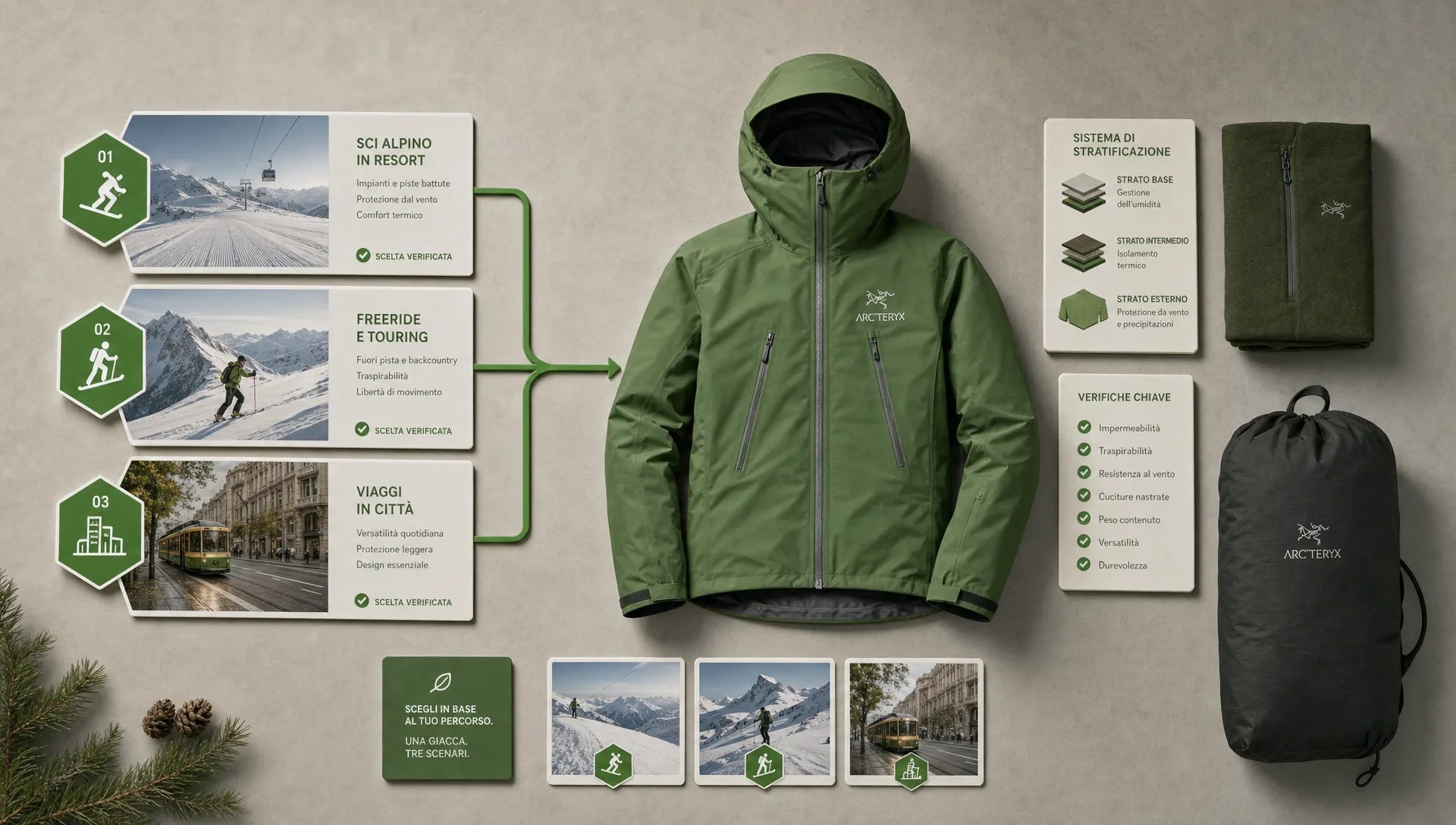
A man’s Arc'teryx jacket is not chosen from the most technical model, but from the activity in which he will have to work better. Skiing on track, freeride, trekking, travel and city ask for different protection, different weight and a different fit under backpack, helmet or urban coat.
This guide is designed for those who want to buy well, without overlapping similar garments or choosing a jacket too specialized for real use. The criterion is simple: first scenario, then rhythm, then layering.
Summary: Quick Choice
- For ski resort and weather days, choose a protective shell with space for a thermal layer below.
- For freeride, ski mountaineering or intense activity, it favours breathability, freedom of movement and compatibility with backpack and helmet.
- For trekking and outdoor use all year round, a light and compressible jacket is often more useful than a very structured garment.
- For cities, travel and commuting, evaluate an insulating jacket or an essential shell with clean cut.
- If you are undecided between two sizes, try to reason on the layer more often than you will wear below, not only on the t-shirt.
Starting from activity, not from the model
The correct question is not which is the best Arc'teryx jacket man ever. The question is where you will use it more often and with what intensity.
A perfect head for a static day on the plants can be too hot uphill. A light trekking jacket can be little protective in a day of wind and snow. A clean model for the city can also work well on the way, but it does not always replace a technical shell in the mountains.
| Main Activity | Real Priority | Type of jacket to look for | What to avoid |
|---|---|---|---|
| Skiing in resort | Wind protection, snow and weather changes | Waterproof shell with layering fit | Too tight heads if you use thermal midlayer |
| Freeride and ski mountaineering | Breathability and mobility | Technical shell or protective softshell | Very hot jackets if you climb a lot |
| Trekking and hiking | Weight, practicality and modular protection | Lightweight or softshell shell | Too voluminous heads in the backpack |
| City and commuting | Esthetic cleaning and daily comfort | Insulating jacket or essential shell | Alpine solutions if you don't need |
| Journey | Versatility and reduced footprint | Compact shell or light insulating head | One piece designed for extreme conditions |
If you are building a technical wardrobe from scratch, start fromArc'teryx collectionand filter mentally for activities: snow, fast mountain, trekking, urban use. It is the cleanest way to avoid duplicate purchases.


For a weekend in the snow, the jacket is just part of the system. If you leave Biella or want to simplify the organization, you can join the clothing to theski and snowboard rental in Biella, to focus on fit, protection and comfort without having to handle all the equipment.
Fast decision for scenario
- If you spend many hours on plants, choose protection and space for layering.
- If you climb with skins, choose breathability and low weight.
- If you walk in different seasons, choose modularity.
- If you need only one jacket for city and travel, choose essential line and comfort.
- If you want a garment to hold for a long time, it prefers a clear use compared to the maximum specialization.
Guscio, softshell or padded: what really changes
Arc'teryx works on very different product families. Without entering into specifics that change from season to season, it is advisable to distinguish three logics: protection, movement and heat.
The waterproof shell is the most rational choice when the weather is the dominant variable. You don't have to heat yourself, you have to protect. Add it to baselayer and midlayer according to temperature. It is the most suitable solution for skiing, mountaineering, hiking in unstable conditions and trips where rain is likely.
Softshell is smoother in movement and more enjoyable in active activities. It is not the answer for every storm, but it is often more comfortable when the body produces heat: climbs, fast walks, dry exits and suction cups, days where you want less rigidity.
The padded jacket serves when the problem is cold. It can be external in the city or in dry conditions, or thermal layer under a mountain shell. For dynamic use, it seeks a more breathable logic; for static use, it seeks comfort and ability to retain heat.
| Category | When it makes sense | Strong point | Limit to be considered |
|---|---|---|---|
| Waterproof shell | Unstable weather, skiing, hiking exposed | Protection and modularity | Requires a warm layer below |
| Softshell | Intense movement, dry or variable climate | Comfort and breathability | Less suitable for persistent rain |
| Padded jacket | Cold, breaks, city, travel | Immediate heat | It can be too hot uphill |
| Technical Midlayer | Layering under shell | Seasonal versatility | Not always enough as outside |

Fit man and layering: the right size is decided with what you wear below
The fit of a technical jacket should not be judged as a casual jacket. A man Arc'teryx jacket must leave movement in the shoulders, do not rise too much when you raise your arms and do not compress the heat layer below.
For skiing, ideally try the jacket with a baselayer and a midlayer. If you use it over a padded head, you need more room on your chest. If you use it especially in the city over light knitting, too much line can be less precise.
Check three points before purchase: length sleeves with moving arms, comfort on shoulders and back with backpack, interior space with the layer more often than you expect to use. If you wear helmet or hood under difficult weather conditions, it also assesses compatibility and freedom of the neck.
For those between two sizes, the most practical criterion is this: choose the most adhering size only if you use the jacket in an urban way or with light layering. For skiing, freeride or cold weather, too precise fit can limit isolation and movement.
Our recommended options
The options below are not an absolute ranking. They are useful archetypes to choose more accurately within the available selection. Names of Arc'teryx families can vary by season, availability and version, so always check product card, size and destination before purchase.
| Recommended option | Best for | Key Features | To match with |
|---|---|---|---|
| Versatile waterproof shell, Beta family or similar | Skiing in resort, hiking exposed, travel in variable weather | Protection, technical cutting, transversal use | Technical baselayer, thermal midlayer, ski or outdoor pants |
| More alpine shell, Alpha family or similar | Freeride, mountaineering, days in a harsh environment | Protection-oriented construction and technical activity | Light heat layer, technical gloves, compatible backpack |
| Technical Softshell, Gamma family or similar | Trekking, climbs, active use with non-extreme climate | Mobility, comfort and good body heat management | T-shirt technique, trekking pants, outdoor shoe |
| Synthetic insulating jacket, Atom family or similar | City, travel, mountain breaks, layering under shell | Practical heat and good daily versatility | Outer gum in case of unstable weather, clean technical pants |
| More breathable insulation jacket, Proton family or similar | Ski mountaineering, dynamic activities, cold moving | Heat manageable during effort and rhythm change | Baselayer light, shell in the backpack, essential accessories |
| Composable Light Shell | Summer trekking, travel, emergency weather | Reduced footprint and ready-to-use protection | Midlayer Slim, hiking pants, daypack backpack |
If your goal is a clean outdoor aesthetic with daily use, you can compare the Arc'teryx approach with brands likePatagoniaandThe North Face. It is not a matter of logo, but of fit, feeling on and type of activity for which the boss was thought.


Skiing in resort
For the track, the priority is to stay protected without sacrificing mobility. A shell jacket is often the most flexible base, because you can increase or reduce heat by changing midlayer. If you are cold or ski with many breaks, an insulating solution can be more comfortable, but less modular on mild days.
Freeride and ski mountaineering
Here the rhythm changes. Uphill the body produces heat, downhill serves protection. Too hot jacket can become a limit. Look for a balance between protection, breathability and freedom of movement, especially if you use backpack, helmet and technical equipment.
Trekking and outdoor all year round
For walks, trips and seasonal exits, the most expensive item is not always the most suitable. Often it works better a light jacket, well matched to an intermediate layer. The advantage is modularity: you can use the shell when needed and leave it in the backpack when time improves.
City, commuting and travel
In the city also counts the way the jacket integrates with the rest of the wardrobe. An insulating model or an essential shell can work well with technical trousers, clean denim or outdoor shoes. If you move between office, train, airport and weekend out, choose a boss who doesn't seem out of context as soon as you leave the mountain.
Care and duration: the technical chief makes it better if you treat it as a technical chief
A technical jacket should not be left dirty throughout the season. Sweat, dust and residue can reduce perceived comfort and performance. Always follow the internal label and use products suitable for technical leaders.
For garments with waterproof membrane, official indications ofGORE-TEX on product careare a good general reference: proper washing and maintenance of water repellent treatment help maintain the jacket efficient over time.
Before storing the jacket at the end of the season, wash it if necessary, dry it completely and control zip, seams and areas subject to abrasion. If you use it with backpack or rocky environment, this test avoids small problems when using the next season.
Frequently asked questions
What suit Arc'teryx man choose to ski on track?For most resort skiers, a waterproof shell with space for layering is the most versatile choice. If you ski with many breaks or suffer cold, consider an insulating jacket or a warmer midlayer under the shell.
Is a Arc'teryx city jacket good in the mountains?Depends on the boss's family. Some jackets have a clean aesthetic but are born for technical use, others are more suitable for everyday comfort. Always check destination of use, weather protection and freedom of movement.
Better shell or padded jacket?The shell protects from wind and rainfall, but does not heat much by itself. The padded jacket warms more, but it can be less modular. If you want a solution for multiple tasks, more midlayer shell is often the most flexible choice.
How to choose the size of a men's Arc'teryx jacket?Try it ideally with the layer you will use most often below. For ski and mountain leave space basedlayer and midlayer. For city and travel you can prefer a more precise fit, provided you do not limit shoulders and arms.
Can a softshell replace a waterproof shell?Not always. The softshell is very good for movement, comfort and exits with manageable weather. If you expect persistent rain, wet snow or strong wind at altitude, a waterproof shell remains more indicated.
Choose the jacket from real use, then check fit and layering. You can explore the Arc'teryx online selection on Fabbrica Ski Sises, with free shipping in Italy from 50€, fast delivery and return within 14 days. If you have doubts between two options, better ask for advice before purchase: a chosen technical jacket works better and lasts longer.
Ski Sises on Google
Choose Ski Sises as a preferred source: you'll see our guides and news more often in Top stories on Google.