
Sale Ski: when to buy new, used or rental
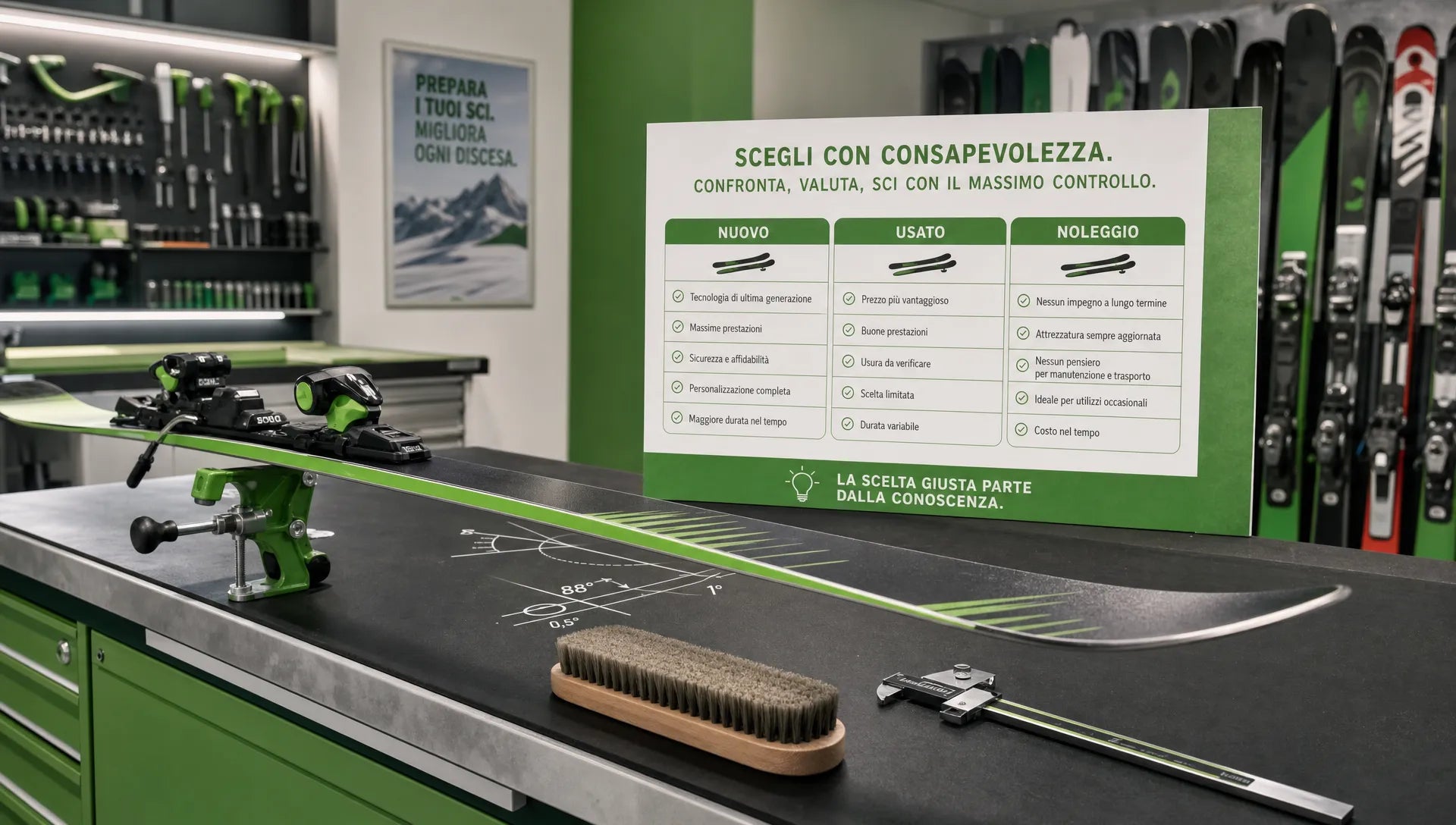
Choosing between new, used skis or rental is not only a question of price. It is a decision that touches security, technical progression, frequency of use and convenience of travel. The search “ski sale” often leads to a more precise question: is it really worth buying, or is it better to rent again for a season? This guide is designed for trackers, families, evolving beginners and more experienced riders who want to buy with criterion, without chasing the wrong opportunity.
In short: the right choice
- Buy new skis if you ski regularly, know your style and want consistent performance for more seasons.
- Evaluate the use only if you can control structure, lamine, insole and attacks from a competent laboratory.
- Choose the rental if you ski a few days a year, you’re learning, traveling often or want to test different categories.
- For many beginners, the first smart purchase is not skis, but well-chosen boots and ski rentals.
- If you are already comparing models, you can start from the selection of skis for sale and then verify length, level and intended use.
New, used or rental: the decision-maker
The best choice comes from three simple questions: how many days you do on the snow, how much your level is defined, how much you want the equipment to always respond in the same way.
| Profile | Most indicated choice | Why it works | Attention to |
|---|---|---|---|
| Beginner, 1-5 days a year | Rental | Reduces initial cost and allows to change size or category | Do not rent skis too long or rigid |
| Beginner who wants to improve | New ski boots + ski rental | Improve comfort and control without immediately blocking the choice of skis | Needs a thorough proof of the boot |
| Intermediate, 8-15 days a year | Skiing new | Increased continuity, better feeling, sensible investment | Choosing a category too technical can slow progression |
| Advanced or expert | New skiing or targeted testing before purchase | It allows you to search for accuracy, stability and consistent response | Personal preferences count very much |
| Family with growing children | Rent or use controlled | Children quickly change height, weight and level | The attack must be regulated professionally |
| Traveler flying often | Rental in destination | Less transport, more flexibility | Better book in high season periods |
The practical rule is this: the more often and predictable, the more the new makes sense. The more your use is occasional, variable or tied to a single holiday, the more rental remains rational.
When buying new skis
Buying new skis is the most solid choice when you want your equipment, always the same, adjusted on your needs and ready to follow you for more seasons. It does not mean buying the most technical model available. It means buying the right model for level, soil and rhythm.
New skis have a clear advantage: you know where they start. Lamine, insole, structure and attacks do not have a hidden story. This is important for those who want to improve, because a constant response under the feet helps to understand what depends on technique and what depends on the tool.
You should buy new if you recognize yourself in at least two of these points:
- Skiing for at least 8-10 days per season.
- You understand if you prefer beaten track, variable snow, freeride or mixed use.
- Renting often feels limits of precision, stability or comfort.
- You want to schedule more exits during the season, not just a white week.
- Looking for equipment to keep and know over time.
The new is also more interesting for advanced skiers, because it allows you to choose a coherent geometry and structure with personal style. Those who ski strong on the track will look for stability and hold. Those who alternate pistes and track edge will look for more versatility. Ski mountaineering or freeride will need an even more technical reasoning, including weight, attacks, boots and safety.
To complete a mountain set, clothing is not secondary. Technical layers, shells, backpacks and accessories affect comfort as skis. If you are building a functional wardrobe for several seasons, you can explore a technical selection asThe North Faceo, for more dynamic exits between mountain and trail, the collectionLa Sportiva.
When use makes sense
The use can be a good choice, but only if you consider it a technical purchase, not a deal to be evaluated at the eye. A ski apparently in order can have very consumed foils, dated attacks, thinned insole or internal damage not obvious.
It makes sense to look at the used in three main cases. The first concerns children and boys, especially when height, weight and level change quickly. The second concerns occasional skiers who want to reduce the initial cost, however accepting some limits. The third concerns those looking for a second pair for specific use, knowing exactly what it is buying.
Before buying used skis, check at least these elements:
- Insole without deep cuts near the lamines.
- Lamina with sufficient material for future maintenance.
- No opening, swelling or delamination on the sides.
- Fits compatible with the boot and still adjustable in safety.
- Length and stiffness suitable for the real level, not at the desired level.
The most delicate point is attacks. It is not enough that “they seem to work”. They must be controlled, regulated and verified by those who work on ski and snowboard with appropriate tools. If you buy used, you will immediately predict a workshop passage for maintenance and repair, especially before the first exit.
Then there is the theme boots. Buying used boots rarely is the best solution, because the inner shoe fits the foot of the previous owner and may have lost support. For an advanced beginner, a pair of ski boots chosen well and ski rental is often more sensible than used skis and imprecise boots.
When to choose the rental
Rental is not a “minor” choice. It is the smartest solution when your use is still variable or when you want to keep freedom. It is for those who ski a few days a year, for those who are learning, for those who travel without wanting to carry equipment and for those who want to try different categories before buying.
Rental is particularly useful if you are changing level. In the first seasons, too technical skis can make the ski more tiring. A more permissive ski, chosen correctly based on day and ability, helps to progress better. The same applies to those who pass from the track to freeride or ski mountaineering: before investing in a complete set, testing has a lot of value.
For those who leave Biella or prefer to organize in advance, ski and snowboard rental allows you to choose the equipment in a practical way, with the advantage of having a physical reference point for advice and adjustments.
The rental is less indicated when you ski many days, you have very specific needs or you want an identical answer every time. In that case, the continuity of your personal set becomes a real advantage.
When to buy: the smart calendar
The time of the year changes availability, choice and convenience. There is no perfect month for everyone, but there is a timing consistent with your goal.
| Period | Ideal for | Main Advantage | Limit |
|---|---|---|---|
| Season start | Who wants to choose calmly | Larger availability of models and sizes | Less opportunities than the end of the season |
| Full season | Who needs it now | You can decide according to the actual conditions and scheduled exits | Some measures can be exhausted |
| End of season | Expert skiers or those who already know what they are looking for | Possible seasonal promotions | Limited choice |
| Out of season | Planning, maintenance, clothing | Time to evaluate without haste | Less urgency, but also less specific assortment |
If you are beginner, better avoid impulsive purchases at the end of the season only because the price is interesting. If you are advanced and know exactly length, category and behavior you are looking for, the end of the season can be a good time.
For those who also buy clothing and accessories, logic is different. Technical layers, bags, fleece and outdoor garments are also used outside the white week. An essential collectionBiella Fabricscan make sense for those looking for versatile items, clean and suitable for daily use beyond the mountain.
Fit, size and level: what to rate before deciding
The measure of skiing is not chosen only according to height. It counts weight, level, usual speed, type of snow and soil. A shorter ski tends to be more manageable. A longer ski tends to be more stable. But this is just a simplification: structure and category count equally.
| Factor | More suitable trend | Why? |
|---|---|---|
| Beginner | More permissive and handy skis | Easy curve and control |
| Intermediate progression | Stable but not excessively rigid ski | Helps improve without penalizing errors |
| Advanced on track | Increased precision and support | Improved sealing and higher flow response |
| Use mixed track and variable snow | Increased versatility | Manage different conditions in the same day |
| Children and boys | Current measurement | Growth and level change quickly |
Boots deserve a separate assessment. They must be precise without creating pain, supporting the foot and working well with the ski. Too comfortable in the store can become imprecise on the track. Too aggressive measure can ruin the day. For this, when talking about new purchase, starting from the boot is often the most serious way to build the set.
Clothing also affects choice. If you tend to ski in many conditions, a technical intermediate layer, a reliable shell and well chosen accessories improve temperature management and reduce interruptions. In a clean and functional set, a premium selection asArc’teryxcan be consistent with mountain use, travel and city.

Our recommended options
Here it is not a single “best ski”. The correct choice depends on the profile. These options help you orient yourself before buying, renting or evaluating a used one.
| Option | Ideal for | Key Features | To match with |
|---|---|---|---|
| New slopes | Intermediate and advanced skiers skiing regularly | Consistent response, good grip, precise choice of length and level | Well regulated boots, helmet, mask, technical layers |
| Skiing new all mountain | Who alternates track and snow variable | Increased versatility compared to a ski purely from track | Technical shell, suitable gloves, compact backpack |
| Set freeride or ski mountaineering | Expert skiers with defined objective | More technical choice, to be evaluated together with attacks and boots | Safety kit where required, light layers, dedicated backpack |
| Daily or weekly rental | Beginners, travellers, casual skiers | Flexibility, no transport, adequate equipment at the moment | Personal quality clothing and technical socks |
| Used controlled | Families, growing kids, targeted budget | Lower initial cost, provided technically verified | Immediate maintenance, new helmet or under good conditions |
| New ski boots + ski rental | Motivated and evolving intermediate beginner | Comfort and control from the foot, freedom to change skis | Boot bag, specific socks, professional adjustment |
The most underrated combination is personal boots and ski rentals. For many people it is the ideal bridge between the first exits and the complete purchase. It gives you comfort, continuity and control, without forcing you to choose the ultimate ski immediately.
Errors to avoid
The first mistake is to buy a ski too advanced “to grow”. A rigid, demanding or unsuitable ski to the level does not accelerate progression. It often does the opposite: tired, stiffens and makes the ski less fluid.
The second mistake is to focus only on the price. A cheap used ski can become expensive if it requires important maintenance, if attacks are no longer suitable or if the measure is wrong. A well-chosen rental can be more useful than a little consistent purchase.
The third mistake is to neglect maintenance. Lamine and insole radically change the feeling on skis. Even a good model loses quality if it is not prepared. For those who buy new, schedule regular maintenance is part of the investment. For those who buy used, it is a starting condition.
The fourth mistake is to forget the context. If you always ski in the same place and do many days, buying makes sense. If you do a week a year in different places, perhaps traveling by plane, the rental remains more efficient.
Frequently asked questions
How many days do you need to justify the purchase of new skis?Usually, from 8-10 days to season the purchase begins to make sense, especially if your level is stable and you know what kind of ski you prefer.
Are used skis safe?They can be, but only after technical control. Lamine, insole, structure and attacks must be verified before use, not after discovering a problem on track.
Better buy skis or boots first?For many skiers, especially evolving beginners, boots come first. A correct boot improves control, comfort and confidence even with ski rental.
When should I buy skis on offer?You know what you're looking for. If level, size and use are not clear, a promotion can lead to a wrong purchase.
Is rental also suitable for experienced skiers?Yes, especially to test different categories, travel light or choose specific equipment for a single exit or week.
Can I buy online without skiing?Yes, if you know level, height, weight, ski style and intended use. If you have doubts, better ask for advice before purchase and always check shipping and return conditions.
Choosing between new, used and rental means understanding how much you want to invest in your snow continuity. If you already have a clear idea, start with the selection of skis and equipment online. If you want to evaluate measurement, maintenance or rental with a more precise guide, go to shop in Biella or contact Fabbrica Ski Sises before the next exit.