

























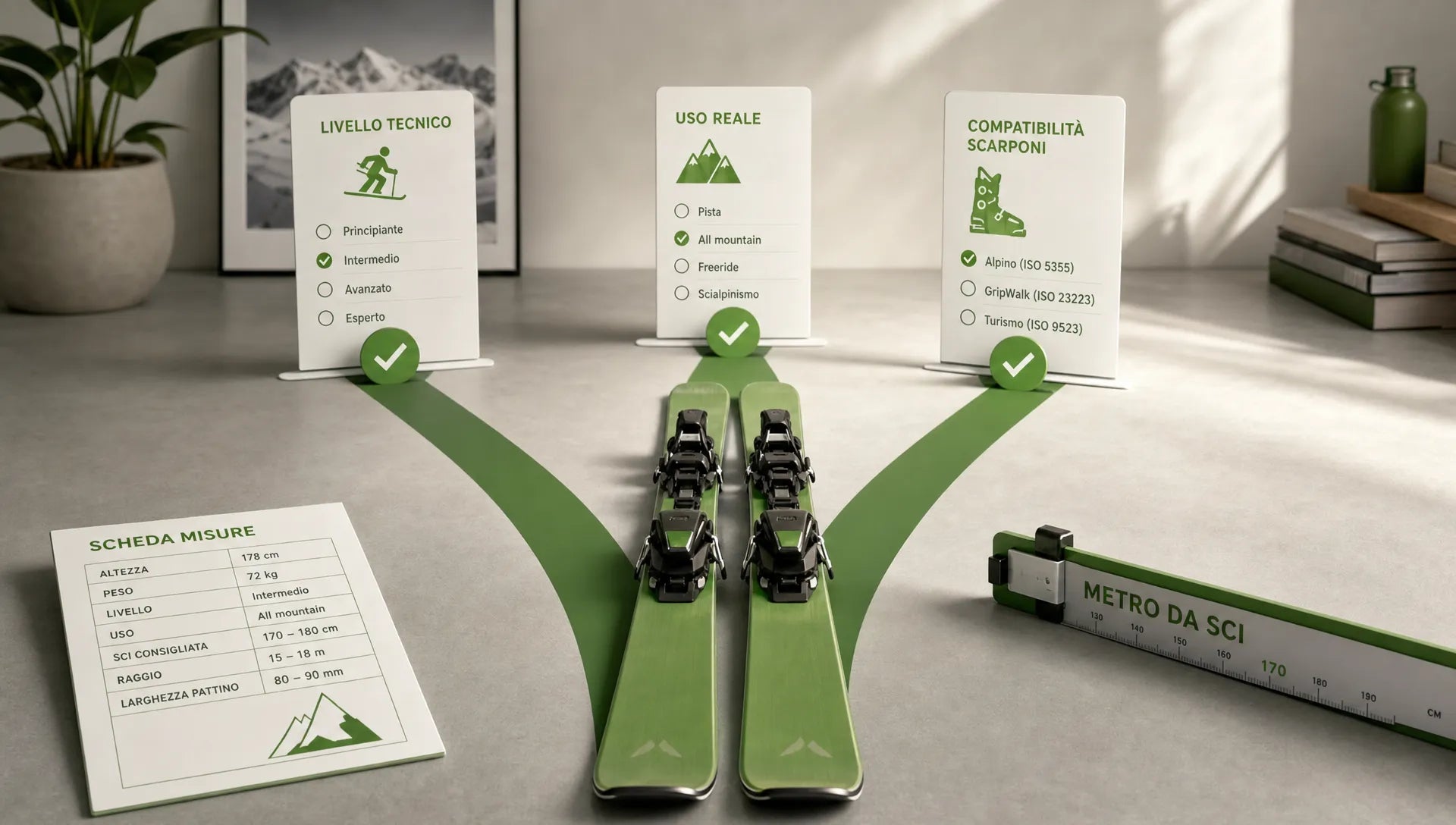
Discount ski: the guide to choose without compromise
A discount ski can be an excellent purchase. It can also become an expensive compromise, if the discount guides the choice more than the size, technical level and type of snow you really face. This guide is designed for those who want to buy well: beginners looking for safety, advanced skiers who want performance, families who need to optimize the budget and fans waiting for the right time to upgrade the equipment. The goal is simple: to understand when a lowered price is really worth and when it is best to go further.
In summary: choose ski discount without compromise
- Start from your real use: track, all-mountain, freeride, ski mountaineering or occasional exits.
- The discount is interesting only if size, category and attacks are correct for you.
- Do not save on boots, adjustments and safety: they are the basis of control.
- For beginners and families, rental can be smarter than immediate purchase.
- For advanced skiers, discount skis are often the best time to climb level.
- Before finalizing the purchase, check compatibility with boots, length, warranty and return possibilities.
Before the discount: define how skiing really
The first mistake is to choose a ski based on the discount percentage. The second is to choose a “more technical” ski thinking that it lasts more. A ski too rigid, too long or too specialized can make the day tiring even if the price was great.
Before you look at the offers, clarify your profile. If you ski a few days a year, you need ease, stability and predictability. If you ski on track often, you can look for more precision. If alternate piste and snow variable, an all-mountain ski can be the most versatile choice. If you do freeride or ski mountaineering, priority changes: weight, width, compatibility and reliability become central.
| If you ski like this | Search | Avoidance |
|---|---|---|
| First seasons or return after years | Progressive, tolerant skiing, easy incoming curve | Race models or very rigid |
| Tourist Board | Stability, good grip, handling | Skiing too wide or specialist |
| Sports equipment | Accuracy, more energetic response, good conduct | Models too soft if you ski fast |
| All-mountain from the area | Versatility, moderate float, mixed snow control | Extreme skiing if you stay almost always on track |
| Freeride or ski mountaineering | Coherence with attack, boots and soil | Insulated purchases without evaluating the complete set |
If you want to compare models and categories, starting from an ordered ski selection for use is more effective than just looking for the highest down.
A practical rule: buy skiing for the days you do most often, not for the ideal day you imagine. The perfect ski for fresh snow can be unnecessarily useful if 90 percent of your outputs are on the beaten track.
| Question | If the answer is yes | Orientation |
|---|---|---|
| Skiing especially on prepared track? | Yes | Track or all-mountain slope-oriented skiing |
| Do I want to improve without getting too tired? | Yes | Intermediate, stable but not aggressive ski |
| I ski fast and lead well? | Yes | More structured ski, to be selected carefully in length |
| Do I often change snow and soil? | Yes | All-mountain with good balance between grip and versatility |
| I don't know what I like yet? | Yes | Currency rental or ski very progressive |
What to really control in a discounted ski
A discounted ski is not automatically a “old” ski. It can be a seasonal stay, a model with selected sizes, a temporary promotion or an assortment choice. The point is not the year of the model, but its consistency with your use.
The discount rate only makes sense after these checks.
- Correct category:track, all-mountain, freeride and touring are not interchangeable.
- Available length:if only a measure away from your range, the discount does not compensate for the error.
- Attacks included or excluded:check what includes the price and if you need mounting.
- Compatible with boots:length hull, standard sole and adjustments must be confirmed.
- Product conditions:on new items, always check description, warranty and return policy.
- Expected use:a more performing ski requires more leg, technique and attention.
For those who are loyal to a brand, brand collections can help to orient themselves without wasting time. A Rossignol collection, for example, allows you to filter mentally between track, all-mountain and more technical products. The same applies if you prefer a wide and transversal proposal like theSalomon collection, useful when you want to compare skis, boots and accessories of the same ecosystem.


The simplest advice remains this: if a product is discounted but requires too much renunciation, it is not the right deal. A ski purchased well must make you ski better, not only cost less.
Where to invest and save
In the ski, smart savings are not evenly distributed. Some elements directly influence safety, comfort and control. Others can be chosen with more flexibility.
The boots, for example, deserve great attention. An excellent ski with an unsuitable boot remains difficult to manage. Attacks, mounting and adjustments are not details: they determine how the equipment works under stress.
If you want to deepen the logic of the budget, the guide onwhat is really worth spending in ski equipmenthelps to distinguish between technical investment and accessory purchase.
| Element | Don't compromise on | Where you can save money |
|---|---|---|
| Skiing | Category, length, technical level | Previous season model if suitable |
| Boots | Fit, consistent flex, comfort, heel seal | Promotions on correct models for the foot |
| Attacks | Compatibility, adjustment, professional assembly | Ski packages more attack if well configured |
| Helmet and mask | Fit, protection, visibility | Previous collections if intact and certified |
| Sticks | Proper length, comfortable handle | Simple but well sized models |
| Clothing | Protection, freedom of movement, layering | End of season and sales on technical heads |
The point is not spending more. It is to spend where the difference feels. On a discount ski, the true value emerges when price, regulation and technical consistency work together.

Our recommended options
These are not product cards, but directions of purchase. They need to figure out what kind of discount ski to look for based on your profile, avoiding choosing only for price.
Progressive track skiing
Ideal if:you're improving, ski on beaten slopes and want a ski that forgives some mistakes without becoming unstable.
Key Features:easy curve input, good handling, structure not too challenging. It is a sensible choice for those who want to spend from occasional rental to personal equipment.
To match:comfortable but precise boots, well stocked helmet and a first technical layer that maintains comfort throughout the day.
Ski sports track
Ideal if:already lead the curves, ski with rhythm and want more precision under your foot.
Key Features:greater stability, more direct response and better grip on compact track. It requires more technique than a tourist ski, so it should be chosen to the correct extent.
To match:boots with good support, mask suitable for variable light conditions and technical jacket with freedom of movement.
All-mountain ski from the ski area
Ideal if:you want only a few skis for slopes, piste and snow not always perfect.
Key Features:balance between grip and versatility, with a construction designed to deal with different conditions on the same day. It does not replace a pure freeride ski, but expands the field of use.
To match:technical pants, well-insulated gloves and modular layers. A selection of well-built ski clothing helps to complete the set without overloading your luggage.
Ski freeride or touring oriented to the ascent
Ideal if:you are looking for off-piste itineraries, sautés or descents in variable snow, with experience and awareness of the soil.
Key Features:the value does not depend only on skiing. It counts the complete system: attacks, boots, skins, safety and expertise. An interesting discount on a single item should be evaluated within the whole set-up.
To match:adequate safety equipment, technical backpack, light layers and reliable protection. In this segment, buying without advice can lead to expensive incompatibilities.
Junior skiing and family
Ideal if:you need to equip children or boys growing up, or you want to manage multiple family outputs without multiplying your spending.
Key Features:ease, correct length and reasonable growth margin, without exaggerating. A ski too long “to make it last” can slow down learning.
To match:helmet, mask, warm gloves and boots carefully controlled. For fast growing children, renting and buying must be compared season by season.
Technical upgrade without changing everything
Ideal if:you already have valid skis but you want to improve the overall experience with accessories or more performing garments.
Key Features:Sometimes the best purchase is not a new pair of skis. A more suitable mask, a more precise boot or proper maintenance can change more than one chosen ski only because it is discounted.
To match:lamine and insole control, technical layering and consistent accessories with the frequency of use.
Size, length and compatibility: quick guide
The length of the ski is not only chosen according to the height. They count weight, level, speed, type of ski and terrain. Two skis of the same length can behave differently if they change structure, split or profile.
For a beginner, a slightly shorter and manageable ski can facilitate control and progression. For an intermediate skier, the measurement approaches more to stature, with variations according to category. For an experienced skier, especially in all-mountain or freeride, it can make sense a longer length, but only if technique and strength are adequate.
| Parameter | Why does it matter | Practical rule |
|---|---|---|
| Height and weight | Influence leverage and stability | Do not only use height as a criterion |
| Technical level | Determine how much ski you manage | More experience allows more structured skis |
| Type of ski | Pista, all-mountain and freeride have different logics | Always compare in the same category |
| Radiation and schiancracy | Change curve input and behavior | Choose according to the ski rate |
| Attacks | They must work with the boot | Check settings before use |
Attacks deserve a separate note. It is not enough that they are already mounted: they must be adjusted for your boots, your weight, your level and your use. The length of the hull in millimeters, the standard of the sole and the width of the brakes are details to check before putting skis on the snow.
If you have doubts between two sizes, do not automatically choose the one remaining on balance. Better to ask for advice and give up a discount than to buy a ski not consistent.
When buying, when renting, when checking
Buying discount skis makes sense when skiing with a certain continuity, you know your style and you found a correct measure. If you are at the beginning, you are changing level or you have to equip growing children, rental can be the most rational choice.
| Scenario | More sensible choice | Reason |
|---|---|---|
| Ski a few days and you don't know your level yet | Rent | Reduce the risk of wrong purchase |
| Ski every season and you have clear needs | Buy discount | Optimize budget and technical continuity |
| You have new boots and old skis | Evaluate ski upgrades | You can build a more consistent set |
| You have skis valid but not sliding | Do maintenance | Lamine and insole change the yield |
| You have to leave soon | Buy only if size and setup are certain | Avoid problems of the last moment |
For those in the area or passing from Biella before the mountain, ski and snowboard rental in Biella is useful to test different solutions before buying. If you already own the equipment, a control in the maintenance and repair laboratory can be more effective than a ski change not necessary.
Maintenance is part of the value. A discounted ski, if well prepared and regulated, can offer satisfactory seasons of use. A neglected ski, though expensive, loses precision and pleasure.
Frequently asked questions
A ski discount of the previous season is a good choice?Yes, if category, length and compatibility are correct. The model season counts less than consistency with your level and type of ski.
How high should the discount be?There is no universal percentage. A moderate down on a perfect ski for you is worth more than a strong discount on a wrong size or on a too technical model.
Better buy discount skis or invest first in boots?If the boots aren't correct, start with them. Comfort, precision and control depend on the fit of the boot.
Can a beginner buy skis at discount?Yes, but it should look for progressive and easy to manage skis. If the level is still uncertain, the rental remains a prudent solution.
Can I mount or adjust the attacks alone?It is not advisable. Assembly and regulation require competence, correct data and technical control. Better to rely on a qualified lab.
Choosing skis without compromise means buying with method: real use, correct size, verified set-up and consistent accessories. If you want to start from a careful selection and receive support before purchase, visit theonline shop of Fabbrica Ski Sisesor go to Biella store for a technical advice before the next exit.
Ski Sises on Google
Choose Ski Sises as a preferred source: you'll see our guides and news more often in Top stories on Google.