

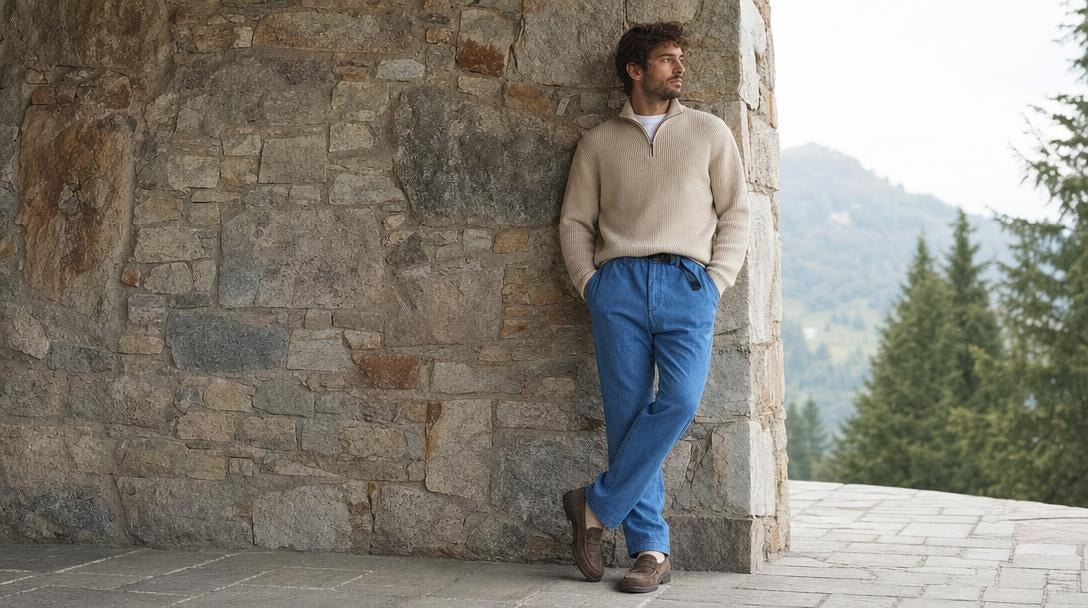
Knit pants: when they make sense and how to choose them well
If you’re looking at knit trousers, here’s the useful answer: they make sense when you want softness, freedom of movement and a relaxed everyday feel. They aren’t automatically the right choice for everyone. Compared with denim, twill or corduroy, a softer pant tends to follow the body more, shows the weight of items in pockets and will reveal creases or sagging sooner if the fit isn’t right.
In the selection Trousers and Jeans you’ll find different categories and that helps more than the fabric label alone. If comfort is your starting point, compare cuts, weights and constructions before deciding whether you really need knit or a trouser that meets the same need more stably.


Knit trousers: when they really work
They usually work well if you want city trousers, casual wear, short-travel pants or days when you’re on your feet for hours but don’t need a very precise line. With sneakers, sweatshirts, overshirts and light jackets, that softness often integrates better than a stiff new pair.
The downside is equally real. If you often carry your phone, keys or wallet in your pockets, or if you want trousers that stay neat after hours seated, knit may be less convincing. The same applies if you need a garment for cleaner settings, where a too-soft leg risks losing presence.
Before you buy, check three simple things: where trousers usually feel tight on you, how many hours you’ll wear them and which shoes you’ll actually pair them with. These details seem small but affect trousers far more than the material name.
Fit matters more than the initial comfort feeling
With soft trousers the fit is crucial. If a model pulls at the thigh or seat, the fact the fabric gives a little won’t make it succeed. Often the opposite happens: wrinkles and tension show up more. A trouser that’s too wide creates a different problem, because it loses shape and becomes harder to wear with clean urban pieces.
So turn your search into concrete questions. Do you need a slim leg or more room at the hip and thigh? Are you looking for trousers to wear many hours away from home or mainly for leisure? Do you want a garment that follows movement or one that builds a more defined silhouette?
This reasoning still applies even if you then choose trousers that aren’t literally knit. In the men’s trousers and jeans selection Ski Sises you’ll find slim, tapered, relaxed and carpenter models: useful categories because they help you start from shape and use, not from a generic term.
If you want softness, you don’t always need knit
Many studies on this topic actually stem from a need for comfort. In that case, the best answer isn’t necessarily a knit. Sometimes a soft cotton, a gabardine with a touch of elastane, or trousers designed to give more freedom where it matters work better.
A concrete example in the collection is Gramicci. The the Gramicci trousers in the selection focus on comfort through specific details: soft-to-the-touch cotton, an elasticated waist with integrated strap, and a gusseted crotch as noted on the product pages. That aids movement and makes the trousers easier to wear for long periods. The trade-off is clear: the language stays casual and rooted in outdoor and climbing, so it’s less suited if you want a tidier look.
The brand’s official guidance is also useful to read fit better. Gramicci distinguishes classic, loose, tapered and wide lines, with different amounts of room at the hip, thigh and leg. It’s a handy reminder: two soft trousers can behave very differently if the cut width changes.
When it’s better to switch to corduroy, gabardine or denim
If you’re choosing for the cold months, a knit isn’t always the most balanced option. A corduroy can give more seasonal weight and a stronger visual presence. A gabardine can look cleaner in mixed contexts between casual work and leisure. A well-chosen denim stands up to frequent use and retains its shape more easily.
For example, Modfitter Carnaby Velvet Uomo Stone works on a different idea than a relaxed soft trouser: 98% cotton and 2% elastane, slim fit and mid rise. It makes sense if you want a more defined winter trouser with a richer hand. The limit is obvious too: if you need extra room at the thigh and knee or a very relaxed fit, this kind of corduroy won’t simplify the choice.
If instead you want more structure, a concrete reference is Dickies Original 874 Work Uomo, described on the pages as fabric with 65% polyester and 35% cotton, relaxed fit and straight leg. The advantage is a more stable line and everyday practicality. The trade-off is a less soft initial hand compared with a more yielding trouser.
If you're leaning toward heavier, more textured fabrics, you may also find our guide on the subject useful corduroy trousers and how to evaluate their fit and use, is especially useful if you’re choosing for autumn and winter.
Shoes change the final result a lot
You can’t judge a soft trouser well hanging up or seen alone. It must be read together with the shoe. With low, clean sneakers, a leg that’s too long or too soft can pile up at the hem and lose neatness. With chunkier shoes, workwear or outdoor-inspired, the same volume often reads as more coherent.
If you mostly wear slim sneakers, it’s usually wise to avoid excess fabric at the ankle. If you wear more substantial shoes, an overly tapered leg can look unbalanced. It’s not a fixed rule, but it’s one of the most useful checks before ordering online.
When you’re buying a duplicate without realizing it
This often happens with searches like this. You already own comfortable jeans, soft chinos or pants with an elastic waist, but you imagine a new knit pant will change how you use them entirely. Sometimes that’s true. Other times you’re just replacing the same function with a different name.
A useful check is simple: does the new piece solve a specific situation where you’re currently uncomfortable, or does it mostly duplicate the use of a pant you already own? If you’d wear it on the same occasions, with the same shoes and the same comfort level, look for a real difference: seasonality, weight, cut or leg volume.
What to check before buying online
- how much room you have at the thigh and seat in the pants you wear most;
- whether you prefer an elastic waist or a more classic closure;
- how much weight you normally carry in your pockets;
- whether you need pants for many hours out of the house or for more relaxed use;
- which shoes you will actually wear with that model.
If any of these points is vague, you risk choosing by feel alone. And with pants that’s where the mistake starts: not with the fabric alone, but with the combination of fit, shoes and frequency of use.
The practical rule is this: choose a knit pant if you truly want softness and a relaxed feel; if you want more shape, seasonal weight or a line that stays more stable, also consider other constructions. To compare them calmly, you can start from the Pants and Jeans selection and check which cut most closely matches how you actually use them.
FAQ
Are knit pants the same as sweatpants?
Not always. In everyday language the two terms are often used as if interchangeable, but they can indicate different garments by hand, drape and appearance. A sweatpant usually suggests a sportier, more relaxed use. A knit pant can look less overtly athletic. To orient yourself, focus more on the garment’s construction than its name: waist, leg hem, presence of drawcords, pockets and how soft or structured the fabric appears.
Are knit pants suitable for winter?
It depends on how cold you are, how many hours you spend outdoors and how substantial the fabric is. For mid seasons, heated interiors and urban use they can work well. If you need pants to wear many hours outside from late autumn through winter, heavier corduroy, sturdy gabardine or denim are often more appropriate. A useful check is to imagine the garment in the toughest situation you’ll face, not the most comfortable.
Can people with thicker thighs find knit pants more comfortable?
It can happen, but only if the cut actually leaves space where needed. A soft fabric won’t fix a tight fit at the thigh and seat. In some cases it makes tensions and wrinkles more visible. If you usually feel discomfort high on the leg, first look for a model with more room at the hip and thigh, then assess the material.
Which shoes work best with men’s knit pants?
They usually work well with clean sneakers, low casual shoes and medium-volume styles. If your lower leg is soft or slightly tapered, a very small-looking shoe can make the hem look heavier. A slightly more present shoe often balances the proportions better. The most useful check is to think about the shoes you actually wear during the week, not a one-off pairing.
Do knit trousers tend to relax during the day?
That can happen more easily than with more structured fabrics, especially if the style is very soft, the fit is already generous or you often carry heavy items in your pockets. It isn’t necessarily a flaw: for some people that softness is the very advantage they’re after. If you want the trousers to stay neater from morning to night, choose pieces with more structure or a less roomy cut to begin with.
Ski Sises on Google
Choose Ski Sises as a preferred source: you'll see our guides and news more often in Top stories on Google.


