Article: Burgundy pants: how to choose them without getting fit or pairings wrong
Burgundy pants: how to choose them without getting fit or pairings wrong
If you’re looking for burgundy trousers, the first question isn’t whether you like the colour. A more useful question is this: will you actually wear them at least once or twice a week, or will they remain the “different” piece you keep putting off? Burgundy can work very well as an alternative to navy, black and brown, but only if the trousers’ fit matches the shoes you wear, the volumes of your tops and the season you’ll wear them in. When it doesn’t work, it’s often not the colour’s fault — it’s the cut being too rigid, the wrong fabric or a combination that demands more attention than you want to give in the morning.
Inside the selection of trousers and jeans it’s therefore better to think in terms of real use. A burgundy corduroy, a gabardine pair or a workwear-style straight leg won’t produce the same effect, even if the shade is similar.


Burgundy trousers: subtle or more present?
This choice decides much of the outcome. A deep, matte and slightly muted burgundy slips more easily into an everyday wardrobe. It pairs well with mid grey, cream, denim, dark blue, olive green and clean sneakers. A more saturated or shiny tone stands out and asks for a neater context.
If you want to wear them often, fabrics that absorb colour rather than reflect it usually help: cotton twill, gabardine, corduroy, dyed denim. The advantage is simple: burgundy looks less formal and less fussy to manage. The trade-off is you lose a bit of crispness if you’re after a tidier or more elegant appearance. For frequent wear, though, it’s often a sensible compromise.
Before you buy, do a very concrete check: which three items would you wear them with tomorrow? If you can only think of a white shirt and a special occasion, you probably don’t need them right now. If you picture them with a sweatshirt, a simple knit, an overshirt or a short jacket, the colour is entering your wardrobe the right way.
Fit matters more than color
On burgundy trousers the cut reads immediately. If they’re too tight, the colour becomes harsher and highlights tension across the thigh and hips. If they’re too wide and you’re already wearing soft volumes above, the risk is a heavy-looking outfit.
For many everyday uses two approaches work well. One is a straight or slightly tapered leg, easy with sneakers, simple derbies or low boots. The other is a relaxed but controlled fit, useful if you prefer softer lines or often wear workwear and outdoor-inspired pieces.
A useful reference, even if in other colours, comes from the Gramicci pieces in the collection: an elasticated waist with an integrated strap, a construction aimed at movement, and relaxed volumes. The official Gramicci page actually separates several menswear fit families, including classic, tapered and wide. That kind of approach is comfortable if you want freedom of movement and trousers that aren’t stiff. But it has a clear limitation: if you’re after a burgundy that also works with neater knitwear or a lightweight jacket, such a casual build can feel too sporty. Before deciding, always check where the leg hem sits on the shoes you wear most often.
At the opposite extreme, a slim or tapered fit can make burgundy look cleaner. It needs careful checking, though. On a colour like this, a thigh that’s too full or a knee that pulls is immediately noticeable, and comfort drops after a few hours. The useful test isn’t standing in front of the mirror—sit down, walk a few steps, bend your knee and see whether the fabric rides up at the ankle or pulls across the front.
The fabric changes the effect: velvet, gabardine, twill, dyed denim
Saying only “burgundy trousers” tells little. The same shade shifts a lot depending on the fabric.
If you plan to wear them mainly in autumn and winter
Velvet is one of the most natural directions. It gives depth, flatters darker tones and pairs easily with chunkier knits, overshirts, waxed jackets or informal coats. In the collection you’ll find, for example, pieces such as the Carnaby Velvet by Modfitter in different tones: they’re useful for understanding the construction and the fabric’s presence. The upside of velvet is that it adds character even to a simple outfit. The downside is equally clear: it’s warmer and can feel too dominant if you spend most of the day in hot indoor spaces. If you’re considering this family specifically, the guide on velvet trousers and how to choose fit and use well.
Gabardine also makes sense for mild cold or transitional seasons. Compared with velvet it looks cleaner and works well with minimalist sneakers, fine knits, shorter jackets and less bulky outerwear. The compromise is that burgundy in gabardine is more exposed: if the fit isn’t right or the tone is too bright, it shows at once.
If you want to wear them across more seasons
Twill and dyed denim are often the easiest options to live with. They read clearly casual and take burgundy from a special occasion colour to a manageable everyday one. The collection includes several cotton, denim and workwear-style trousers, from the Gramicci pieces to the Dickies and even some Edwin models, which help visualise how presence changes.
You don’t need to chase an overly technical trouser or one full of details. If the colour is already prominent, pronounced stitching, utility pockets and showy hardware can add up to too many signals. Better to ask whether that style genuinely fits your usual outfits, or if you’re trying to force together very different characters.
Also check the fabric weight against how you actually spend your week. If you move between car, office and heated interiors, a heavy fabric can tire you more than you expect. If you walk a lot outdoors and want trousers with more substance, one that’s too light may feel out of place by November.
Combinations that really work
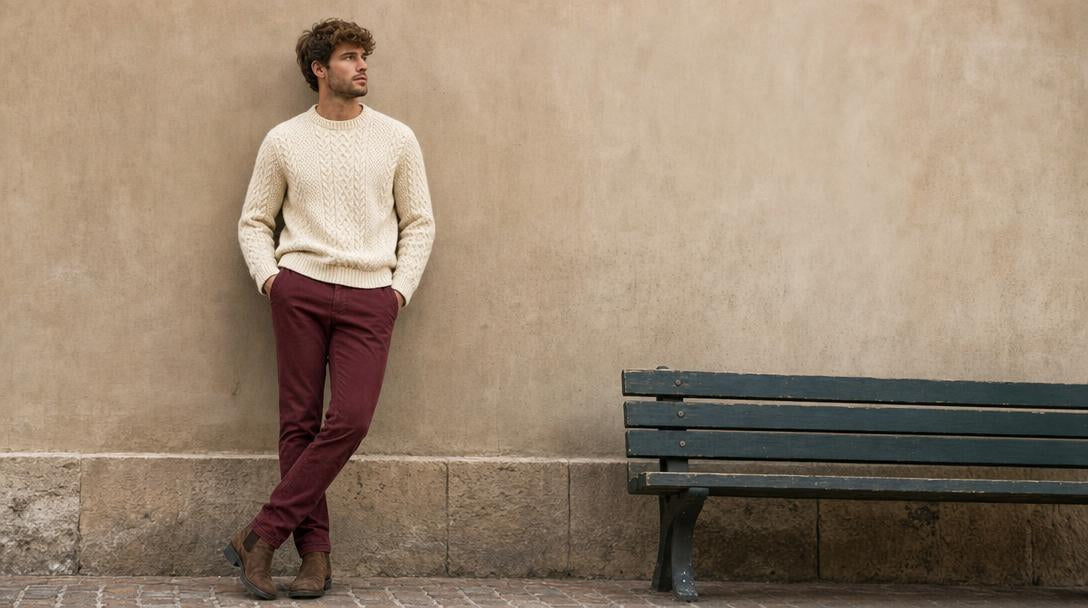
The easiest way to wear burgundy trousers is to keep the rest of the outfit muted. Good tops include cream, ecru, grey, charcoal, navy, mid denim, muted olive and dry beige. For shoes, white or off‑white sneakers, neutral suede, simple dark derbies or low, unobtrusive boots often work well.
Some matches look easy on the hanger but are trickier in daily use. All‑black with burgundy can work but makes the trousers more dominant. Very red‑brown or orange‑brown browns risk clashing without balance. Large prints, bold logos or highly textured tops remove the outfit’s cleanliness.
If your style is urban and you wear sneakers often, check the hem: it should fall neatly without bunching too much at the front. Too many folds over the shoe makes burgundy look untidy; too short and tight it reads stiff.
When it makes sense to buy them, and when to wait
Burgundy trousers make sense if your wardrobe is already built on neutral bases and you want an alternative to the usual navy, black, grey or beige. They also work if you want to add color without jumping to trickier tones like mustard or brick orange.
They’re less sensible as your first truly versatile trousers. In that case it’s usually better to start with navy, dark grey, chinos or mid denim and add burgundy later. Not because it’s unmanageable, but because it works best when the rest of the wardrobe is already clear.
If your question is seasonal, use a practical distinction. For autumn and winter burgundy is strong in velvet, gabardine and denser cottons. For more cross‑season use, twill and denim fit better. If you’re comparing a casual colored trouser with a neater alternative, our guide to wool trousers by season and use.
What to check before buying online
- The actual length with the shoes you wear most, not with an occasional pair.
- Thigh and seat room when you sit down.
- Whether the fabric suits the months you’ll actually wear them.
- Whether the color leans more toward wine, plum or reddish‑brown, since matches change accordingly.
- Whether you already own at least two tops and a shoe that make them work without much thought.
The simplest rule: if you intend to wear burgundy trousers often, start with an easy fit and a matte fabric; the color comes later. If you want a more characterful piece to wear occasionally, you can afford a fuller tone or a more present fabric. To compare cuts and constructions at leisure, explore the Trousers & Jeans collection and check which line truly matches your way of dressing.
FAQ
What shoes should you wear with burgundy trousers without weighing the look down?
For everyday use start with simple shoes: white or off-white sneakers, beige or taupe suede, clean dark derbies, or minimal loafers. Burgundy already draws attention to the lower half, so shoes with too many contrasts, chunky soles or flashy details can add unnecessary visual weight. The practical check is the relationship with the hem: with low sneakers you want a neat fall; with more structured shoes you can tolerate a slightly fuller leg.
Can burgundy trousers work in spring too?
Yes, if the fabric isn’t too heavy. In velvet or dense gabardine burgundy reads more wintry because it feels seasonally full. In cotton twill or dyed denim it can work well in spring, especially with lighter tops like cream, light grey or medium denim. If you want a trouser you’ll wear across several months, avoid overly heavy or shiny fabrics.
Can burgundy trousers work in a neater outfit?
They can, provided the trouser has a clean construction: regular line, few utility details, and a surface that doesn’t look too sporty. In that case pair them with fine knitwear, an Oxford shirt, a sober overshirt or an unstructured jacket. They remain less neutral than navy or grey. If you need a near-formal staple you’ll wear often, burgundy isn’t the first choice; if you want a tidy but less predictable look, it makes sense.
If I have big thighs, will burgundy trousers emphasize them more?
They can if you pick a fit that’s too slim. The issue isn’t the color alone but that on burgundy trousers fabric tensions show quite clearly. Usually go for a straight or slightly tapered leg with extra room at the top, avoiding very tight slims. The true test is in movement: sit, walk and check for tense front wrinkles or any pulling at the knee.
Which colors are easiest to pair with burgundy trousers?
The easiest colours are cream, ecru, mid grey, charcoal, navy, denim blue and muted olive. They work because they let the trousers play the main role without creating confusing contrasts. Cool beiges and browns can also work as long as they don’t skew too reddish. For simple combos think a grey sweatshirt, a cream sweater or a navy overshirt.
Ski Sises on Google
Choose Ski Sises as a preferred source: you'll see our guides and news more often in Top stories on Google.