
Ski sale stores: when it is best to buy in store
Buying ski in store is not always necessary. But when the choice depends on posture, technical level, weight, purpose of use and compatibility with boots and attacks, the physical store becomes much more than a point of sale. If you're typing ski stores in the planning stage, you probably want to figure out whether it's worth going to the store or if you can order online risk-free. The short answer: it is best to buy in store when the error of choice costs more than the discount found online.
In summary
- You should buy in store if you buy the first set, level changes, discipline changes or have customised doubts and stiffness.
- The physical store is decisive for boots, attacks, adjustments, compatibility and technical advice.
- The online works well for already known replacements, clothing, accessories and targeted repurchases.
- Before buying, renting and lab services can help you understand what you really need.
- The best time depends on the priority: wide choice at the beginning of the season, occasions at the end of the season, urgency before the trip.
When the physical shop really makes the difference
A ski is not only evaluated by length. It counts the type of use, average speed, soil, frequency with which you ski and the margin of growth you want to leave. Too permissive model can limit you after a few exits. Too busy can make you ski contract throughout the season.
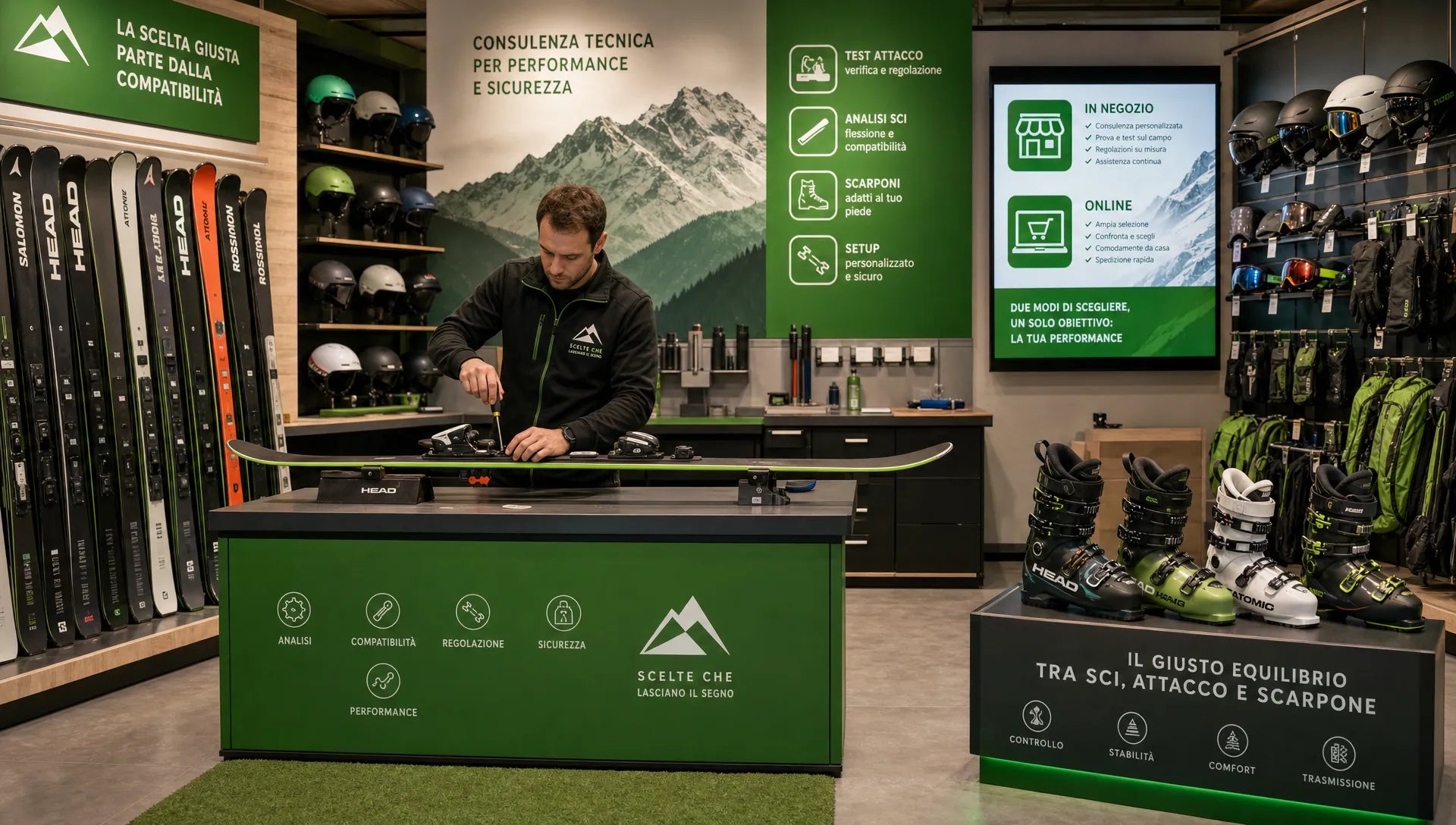
In specialized ski shops, the value is not only the display of products. It is the conversation with those who can translate your way of skiing into a concrete choice. This difference is felt especially in four cases.
First purchase or return after years
If you are buying your first pair of skis, or go back on track after a long time, the store helps to avoid two frequent errors: buy according to aesthetics or choose a model too technical because considered more performing.
A good consultant starts from simple questions: where you ski, how many days you do a year, on which slopes you feel safe, if you prefer quiet curves or sustained rhythm, if you already have a boot of yours. From there, narrows the choice.
Boots and comfort
Even if the article speaks of skiing, the boot often decides the quality of the day. A correct ski with a wrong boot does not work well. In store you can evaluate volume, heel seal, pressure on the neck of the foot and feeling in flex position.
The declared size is not enough. Feet with same length can have very different widths, arches and volumes. This is why the test in the store remains one of the strongest reasons to buy live.
Mounting and adjusting attacks
Attacks are not a detail. The adjustment of the release values, often called DIN, depends on parameters such as weight, height, age, shoe sole length and skier level. Mounting must be done with correct tools and procedures.
Buying skis in store makes sense when you want to get out of the store with a consistent system: ski, attack and boot checked together. It is a choice of performance, but also safety.
Freeride, touring and splitboard
Outside the beaten track, compatibility weighs even more. Attacks, boots, skins, ski width, rampant, backpack and clothing must work as a system. Here technical advice reduces the risk of buying pieces valid individually but not suitable for each other.
For those seeking technical credibility, the physical store remains a useful filter. It does not replace training, bulletins and prudence, but helps to build a more rational setup.
Store or online: how to decide without wasting time
The point is not to oppose physical and digital store. It is to understand which channel best serves the decision you have to make. Also in other sectors, buy from oneofficial store of an independent artistmeans choosing a nice channel instead of an indistinct point. In the ski material, this clarity is even more important because the product must work on the body, snow and the rest of the equipment.
| Situation | Better in store? | Why? |
|---|---|---|
| First pair of skis | Yes | Serves to interpret level, objectives and correct measurement |
| New boots | Yes | Fit, volume and pressure points must be tested live |
| Mounting attachment | Yes | Requires adjustment and technical control |
| Replacement of an identical product | Not always. | If you know model and size, the online can suffice |
| Technical clothing | Depends. | In store for fit and layering, online if you already know fit |
| Technical gift | Often yes | Better avoid wrong measures and compatibility |
| Rental before white week | Yes | Allows quick choice and immediate verification |
The online is ideal when you already know what you want. For example, if you need to replace an accessory, buy a head already tried or complete a technical outfit. In these cases they count availability, fast shipping, simple making and assortment treated. Fabbrica Ski Sises also offers online purchase with free shipping in Italy over 50€, fast delivery and return within 14 days, useful when the choice is already clear.
Checklist to do in store
Entering the store without preparation can lead to a guided choice only from the immediate. Better to get there with a few precise information. You don't need to be experienced, you need to be honest about your level.
- Bring the boots if you already own them, because they affect attacks, position and compatibility.
- Explain where you usually ski: piste, turned snow, fresh, touring or mixed use.
- Indicate how many days you do in a season and if you want to grow technically.
- Communicates weight, height and level realistically, especially for attacks and structure choice.
- If you had pain in your feet or knees, say it now.
- Ask why a length is recommended and what compromises entails.
- Check time and installation, preparation and maintenance costs.
- If you are undecided, consider the rental as a test before purchase.
This checklist is also useful for those who buy clothing. A shell, fleece or technical trousers must leave freedom of movement, space for layers and protection consistent with the temperature of use. For those looking for technical garments to use even beyond snow,selection La Sportivais a good starting point to build a functional outdoor wardrobe.
Time factor: when buying in store during the year
The time of purchase changes the type of advantage. At the beginning of the season you will find more choice and more time for advice, assembly and adjustments. Close to the holidays you find speed, but less margin. At the end of the season you can intercept occasions, however accepting a more selective assortment.
| Period | Advantage | Limit |
|---|---|---|
| Pre-season | More choice and time to decide | Prices often less aggressive |
| Winter start | Good balance between choice and urgency | Sizes and models begin to shrink |
| Before the white week | Quick Solution and Targeted Consulting | Less time for testing and alternatives |
| End of season | Possible occasions | Limited availability |
| Summer | Ideal for maintenance and planning | Winter assort not always complete |
If you have a white week already set, do not wait the last days for boots and attacks. The rush leads to compromise. If you are building a technical wardrobe for several seasons, you can move more calmly, also evaluating versatile items for travel, hiking and urban use. In this logic, theThe North Face selectioncan be useful for those looking for items and accessories designed to switch from outdoor to city.
Our recommended options
There is no right purchase for everyone. There is a choice consistent with how you will use the equipment. Here is a practical reading to guide you.
| Recommended option | Ideal for | Key features to evaluate | To match |
|---|---|---|---|
| Ski track or mountain set purchased in store | Resort skiers who want performance and control | Length, radius, structure, required level, mounting attachments | Verified boot, helmet, mask, technical fit |
| Shoe chosen with accurate proof | Advanced beginners, experts and those seeking real comfort | Volume, support, pressure, heel seal, bending position | Planting if necessary, thin technical fit, compatible trousers |
| Rental before purchase | Families, beginners, occasional skiers | Possibility to understand preferences before investing | Helmet, gloves, thermal layers, insurance if required |
| Setup freeride or touring | Advanced skiers and those who come out from only track context | Shock-attack compatibility, weight, width, skins, safety accessories | Technical backpack, shell, insulation layer, adequate training |
| Ski and outdoor technical layering | Who wants versatile garments for snow, trekking and travel | Freedom of movement, breathability, protection, duration | Mid-layer, shell, thermal accessories; for fibers and essential garments also evaluatesBiella Fabrics |
| Online targeted accessories and replacements | Who knows already size and preferences | Availability, return, compatibility with what you have | Bags, stockings, gloves, protections, maintenance products |

Fit and sizes: what to try live
The fit isn't just about the boot. It concerns everything that affects movement. In store you can simulate a position closer to the ski: folded knees, active bust, free arms, overlapping layers.
For boots, the initial feeling must be precise, not as comfortable as a walking shoe. The fingers can touch the toe, but the heel must remain stable when pushed forward. If the foot slips or feels side blanks, the transmission to the ski will be less clean.
For clothing, always try thinking about the complete system. An intermediate layer must be under the shell without compressing. A pant should allow bending and rotation. A jacket must protect without limiting shoulders and arms.
For children, the temptation to buy a very abundant size is understandable, but in the ski can penalize comfort and control. Better to assess reasonable growth margin, especially on boots, helmet and protections.
When renting is smarter than buying
Rental is not a choice of filling. It is often the most rational way to understand what it really takes. It is for those who ski a few days a year, for children growing up, for those who want to try a new discipline or for those arriving in the mountains without carrying everything.
In the case of beginners, rent before buying avoids premature investments. After some exits, the level changes quickly and also the perception of the equipment. The ski that seemed stable on the first day can become limiting after a week of lessons.
For those who are experienced, the rental can serve as tests: different lengths, different structures, more or less versatile geometries. After testing, purchase in store becomes more accurate.
The lab counts, too. Lamine, sciolin, background control and adjustments affect a lot on the track feeling. Sometimes you don't need to buy a new ski immediately: you need to work well what you already have.
Quick decision: buy in store or not
If the choice involves measure, safety, compatibility or comfort, choose the store. If it is an identical repurchase or a simple accessory, the online can be more efficient.
| If you recognize yourself in this situation | Recommended choice |
|---|---|
| You don't know which length to choose | Go to the store |
| You have pain with the current boots | Go to the store |
| You need to mount or adjust attacks | Go to the store |
| Do you want to start touring or freeride | Go to the store |
| You have to buy a stocking or an accessory already known | Online is fine |
| Do you want to replace a head with already known size | Online is fine |
| You have to make a technical gift | Better advice in store |
| Start in a few days | Store or rental, to reduce risks |
This is the simplest logic: use the physical store when it serves interpretation. Use the online when you need speed on an already defined choice.
FAQ
Should I buy skis in the store or online?You should buy in store when you have to choose size, level, attacks or boots. The online is more suitable for accessories, already known replacements and garments you know about.
How long before the white week should I buy?Ideally a few weeks before, especially if you have to try boots, mount attacks or prepare skis. Last minute purchases reduce choice and discretion.
Should boots always be tried in store?Yes, if you don't know model, size and fit. The boot is very sensitive to foot volume, arch, heel and position. Accurate evidence avoids many problems on the track.
Does rental make sense before buying?Yes. It is useful for beginners, families, occasional skiers and for those who want to test a different discipline. It can make the next purchase more targeted.
What should I ask when I buy skis in store?Ask why a certain length is recommended, if the ski is suitable for your level, how attacks will be mounted, what maintenance they serve and if there are more versatile alternatives.
Is it better for a child to buy or rent?Depends on frequency and growth. If you ski a few days or change size quickly, the rental is often more practical. If you ski a lot, purchase can make sense with correct advice.
Buying in store is convenient when you want to reduce uncertainty and increase consistency between skis, boots, attack and skiing. If you're planning the season, go to Biella's store for advice or explore the Fabbrica Ski Sises curated collections online to complete equipment, clothing and accessories with more precision.