La Sportiva Mutant 2023: What Really Changed
If you searched La Sportiva Mutant 2023, you are probably in one of these situations: you want to replace your current Mutant without surprises, or you are wondering whether the 2023 update really changes anything for how you run (terrain, pace, distance). The point is not to chase the latest version, but to understand which changes matter: fit, foot lockdown, protection, behaviour on wet and muddy ground, and compatibility with your foot. Here is a practical method to decide, even if you buy online.
-
In short (before going into detail)
- There is no "changes everything" that holds for everyone: on a trail shoe, even small tweaks can be decisive if you are at the edge of your size or run on very technical terrain.
- The differences worth checking are 5: forefoot volume, heel lock, upper structure, perceived stiffness, and outsole and lugs.
- Sensible upgrade if the previous version caused pressure points, instability on descents, or early wear on the upper and outsole.
- Less useful upgrade if your "old" Mutant fits you perfectly and you always use it in the same scenario.
- If you are torn between two sizes, choose based on real use (short technical race vs long runs), not on the size you wear in town.
How a Mutant really changes, without marketing
When a model is updated, its DNA rarely changes. More often, the changes focus on:
- Fit (volume and shape): how much space you have over your toes, how "locked" the midfoot is, how stable the heel is.
- Upper (support and durability): how it handles creases, abrasion, drying, and how it "holds" the foot when the ground moves.
- Outsole (traction and predictability): lugs, compound, behavior on wet rock, mud, firm ground.
The most serious way to understand what changes in the La Sportiva Mutant 2023 is to do one simple thing: compare the official spec sheet with your priorities. If you are buying in the 2026, you may also find stock from different years: in that case, the method below keeps you from buying "from memory".

The 5 checks that make the difference (practical checklist)
You don't need 20 parameters. You need the right ones.
1) Forefoot volume: usable space, not a "number"
Check whether the description (or reliable reviews) mention a leaner or a more generous fit.
Signal you should pay attention to: black toenails on descents or toes hitting the front in technical races.
2) Heel lockdown: stability on descents
This is the variable that changes your sense of security more than any other.
Home test (when it arrives): lace up, then do 10 forward lunges. If your heel "floats", it isn't the right shoe or the right size.
3) Upper structure: containment vs comfort
A more structured upper tends to stabilize but can feel less "forgiving" on wide feet or on very long outings.
Key question: do you want a shoe that locks in and guides, or one that accompanies and forgives?
4) Perceived stiffness: protection and precision
More stiffness often means more protection and directional control on technical terrain, but less natural feel on smooth dirt trails.
If you do a lot of "door to trail" or long runs on forest roads, this point matters.
5) Outsole and lugs: where do you really run?
For the Mutant, the focus is almost always this: technical terrain, unstable footing, mud, grass, rock.
For a reliable refresher on how to choose a trail shoe based on the terrain (without going by the name alone), a general guide such as REI's on how to choose trail running shoes is also useful.
Quick table: priority, what to check, risk if you get it wrong
| Your priority | What to check in the Mutant 2023 | If you get it wrong, what happens |
|---|---|---|
| Stability on descents | Heel, midfoot lockdown, upper structure | Foot moving, blisters, insecurity on technical ground |
| Comfort on long runs | Forefoot, pressure points, heat management | Numbness, stressed toenails, loss of efficiency |
| Grip on wet and muddy ground | Lug type, outsole pattern, user feedback | Slipping, long braking, mental fatigue |
| Real-world durability | Reinforced zones, reviews on abrasion | Fast wear at critical points |
Fit and size: how to tell if the Mutant 2023 fits you "the same"
With trail shoes, size isn't a religion: it's a choice of scenario.
Mini decision tree (no complications)
If you recognise yourself here, you already have a credible answer:
- Technical races, aggressive descents, narrow or medium foot: prioritise containment, avoid excess room.
- Long outings, feet that swell, lots of continuous downhill: prioritise functional room at the toe.
- If you're between two sizes: choose the one that gives you heel stability without squeezing the forefoot.
3-minute test protocol (once it arrives home)
- Walk uphill on stairs for 1 minute: the heel must stay put.
- Simulate a descent (toes pointing down on a step): the toes should not 'hit' the front.
- Do a light twist (as on a side slope): the foot must not slide sideways.
Useful note: on trail it is normal to look for a more 'technical' fit than a city shoe, but it must never turn into compression. If you want an official reference on the model and the brand's guidance, you can start from the website La Sportiva.
When it makes sense to upgrade to the Mutant 2023 (and when it doesn't)
It makes sense if
- You've changed scenario: more technical, wetter, more descent, more pace.
- The version you used left you with constant minor problems (toenails, recurring blisters, unstable heel).
- You want a more current shoe in terms of materials and construction, even with the same overall feel.
It doesn't make sense if
- Your Mutant fits you perfectly and you always use it in the same context.
- You're looking for 'more comfort' for smooth, long dirt tracks: often you need a different model, not a new year of the same model.
If your goal is to buy better and reduce returns, you can also apply the logic of our guide on how to buy sports gear online: shoes are the category where reading product listings carefully really makes the difference.
Our recommended options (based on real use)
You won't find a 'ranking' here, but consistent choices. If you want to see what's available, start from the collection La Sportiva.


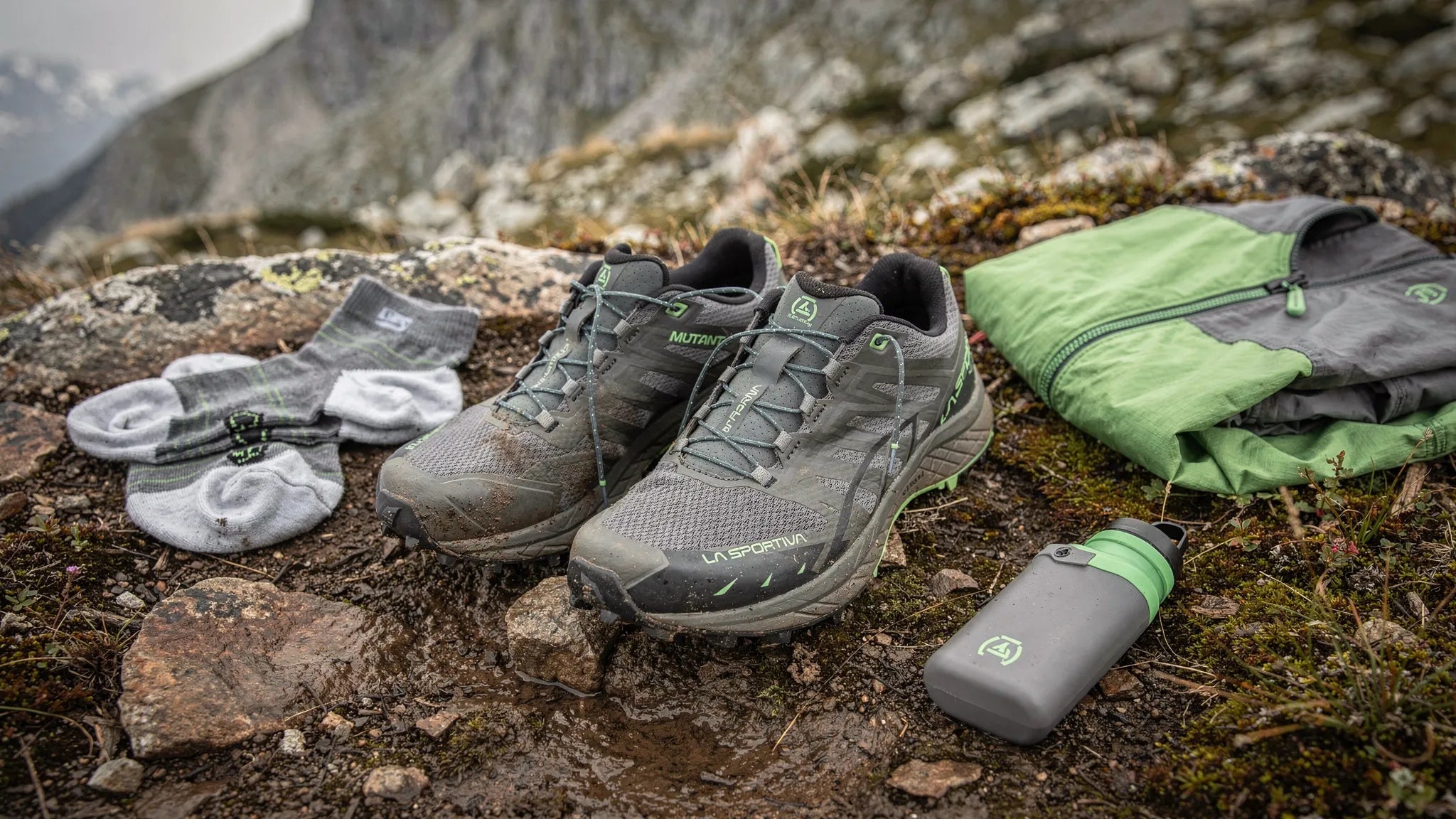
1) La Sportiva Mutant 2023
Best for: technical trail, mixed conditions, when the priority is foot control and traction.
Key features (in practice): stability-oriented construction, a 'guided' feel on changes of footfall, a technical rather than 'soft' approach. (Always check the details on the product listing.)
What to pair it with: an essential kit that handles weather and sweat, for example technical gear and mid layers from the Dynafit collection, especially if you run at altitude or in the mid-seasons.


2) Mutant (previous version) if it fitted you perfectly
Best for: a “like for like” replacement when you have already found your size and don't want to change the feel.
Key features (in practice): continuity of fit and behaviour, especially if you were already comfortable on descents and unstable ground.
What to pair it with: technical socks and lightweight, durable trousers for long outings. If you're looking for a versatile piece beyond trail running, take a look at the Lanapo collection for a more travel-oriented, 4-season approach.


3) An alternative La Sportiva model, if your problem was "too technical"
Best for: for those who love La Sportiva but want more comfort on long runs or more smoothness on compact dirt tracks.
Key features (in practice): the perceived geometry and protection often change, oriented more towards distance and less towards extreme terrain.
What to pair it with: a lightweight shell and a breathable layer, chosen according to your typical weather. If you want to think in terms of kits, the guide to trekking clothing: essential kit and smart choicesis also useful, and works well for trail running and fast hiking.
4) If you're unsure about the overall setup, not just the shoe
Best for: advanced beginners and "trip-based shoppers" preparing a race or a weekend in the mountains.
Key features (in practice): reduce mistakes by looking at shoe, socks, pack/vest, jacket and trousers together. Often it's the combination that causes problems (chafing, heat, moisture).
What to pair it with: if you're passing through Biella and want a practical comparison with the staff, also consider the in-store services and assistance described in Sport service: all services in store (useful for those who want a technical point of reference, in addition to buying online).

Frequently Asked Questions
Is the La Sportiva Mutant 2023 the same as the previous versions? No, "the same" is rarely the right word. Generally the model's identity remains, but small variations in fit, upper or sole can change the feel a lot. The right approach is to compare spec sheets and do test runs as soon as it arrives.
If I have the Mutant and I'm happy with it, should I move to the 2023? Not necessarily. If the fit is perfect and the usage scenario hasn't changed, a consistent replacement is often the most sensible choice. An upgrade makes sense if you want to correct a limitation that has been bothering you for some time.
How do I choose my size for trail running without trying it on in the shop? Start with three checks: heel held firmly, toes not touching on a "fake downhill", and no compression at the forefoot. If you're between two sizes, decide based on distance and elevation gain, not on your city shoe.
Does the Mutant 2023 also work well on smooth gravel and for everyday use? It can work, but if your terrain is mainly compact and linear, a less technical model is often more efficient. In that case, also consider alternatives in the La Sportiva line based on distance and surface.
How much difference does clothing make to the experience with a trail shoe? More than you might think. Wrong socks, sweat management and a backpack that pushes your posture can cause blisters and instability even with the right shoe.
A simple step
If you're considering the La Sportiva Mutant 2023, start from your real availability and compare 2 or 3 options that suit your terrain. You can explore our collection La Sportiva and, if you want a quick recommendation before ordering, contact the Fabbrica Ski Sises team with your usage scenario (distance, elevation gain, terrain, usual size). Free shipping in Italy from €50 and returns within 14 days make it easier to choose calmly, without rushing the decision.
Ski Sises on Google
Choose Ski Sises as a preferred source: you'll see our guides and news more often in Top stories on Google.