































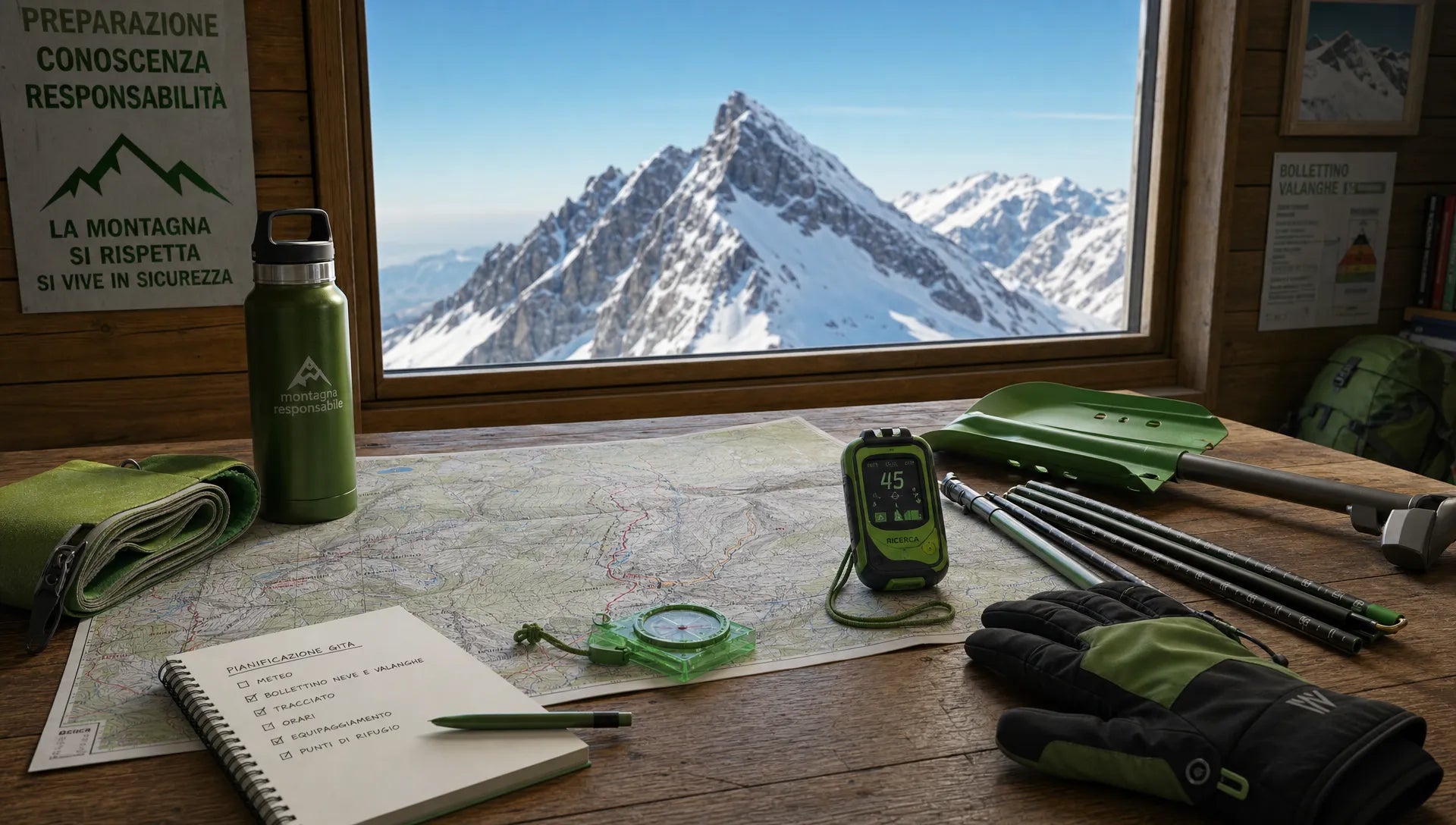
Ski mountaineering equipment: essential checklist
Ski mountaineering asks for a simple and strict thing: bring everything you need, without bringing too much. The difference between a smooth trip and a complicated day is often in prepared details before, such as dry skins, controlled ARTVA, correct layers and ordered backpack.
This checklist is designed for those who are building their own mountaineering equipment, for those who return after a break and for those who want to check the kit before a new season. The goal is practical: choose with criterion, understand priorities and know what to check before leaving.
In summary
- Safety comes before efficiency: ARTVA, shovel, probe and ability to use them are not accessories.
- Skiing, boots and attacks should be chosen according to the type of exit, not only to weight.
- Skins, rampants, sticks and backpack determine a good part of the uphill comfort.
- Layering must manage sweat, wind and breaks, with easy to adjust garments.
- Before buying everything, define soil, technical level, frequency of use and goal of the season.
First choice: what kind of ski lift are you?
There is not only one correct setup. A spring trip on long levels requires different priorities than a freeride exit with short approach. Before looking at models, weights or brands, it is best to clarify the context of use.
| Output profile | Main priority | Equipment to be preferred |
|---|---|---|
| First trips with guide or expert group | Safety, simplicity, comfort | Reliable set, comfortable boots, backpack ordered |
| Long differences and constant rhythm | Uphill efficiency | Light skis, boots with good mobility, breathable layering |
| Freeride touring | Downhill stability | More structured skiing, helmet, protections and large backpack |
| Spring exits | Dust and heat management | Rampant, glasses, light layers, sunscreen |
| Travel and weekend in altitude | Versatility | Complete kit, compressible garments, durable bag |
If you are at first, avoid the temptation to choose the most extreme equipment. A very light setup can be pleasant uphill but less stable downhill. A very downward-oriented setup can become tiring on long climbs. The best solution is that you can use well, often and safely.
If you want to try materials before buying, or prepare a week in the mountains without immediately investing in the whole kit, ski and snowboard rental in Biella is a sensible choice to understand measures, feelings and real priorities.
Essential checklist: safety, movement, clothing
The checklist is divided into three blocks: self-awakening, progression and protection. Jumping one means leaving a part of the exit uncovered.
Security and self-awareness
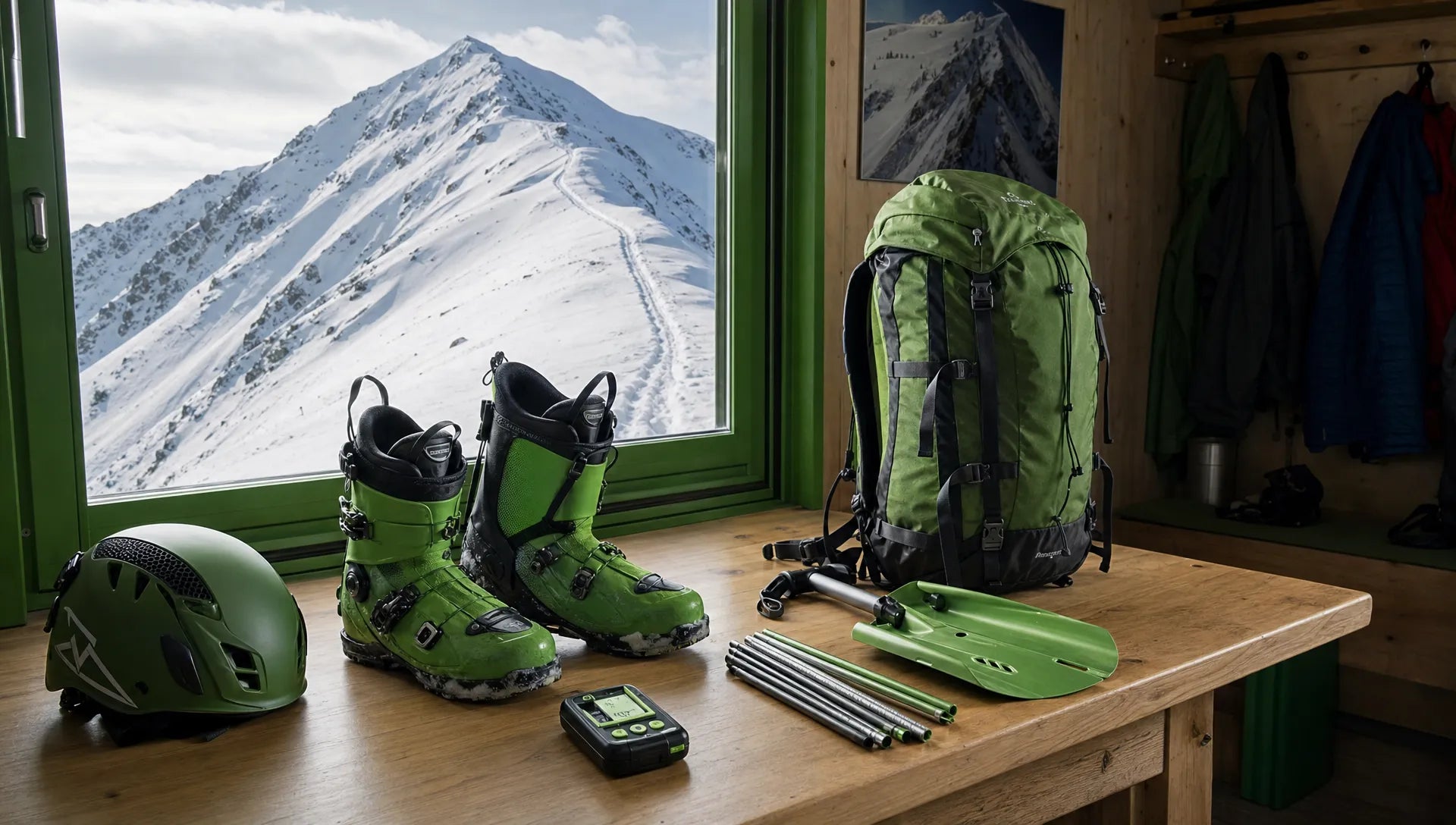
For ski mountaineering, the safety kit is not negotiable. ARTVA, shovel and probe must be present, functioning and accessible. More importantly, they must be tested regularly. To possess the material is not equivalent to using it under stress.
Before each exit, consult the avalanche bulletin. In Italy you can start from the resources ofAINEVA, while for a wider alpine reading the portal ofEuropean Avalanche Warning Services. The bulletin does not replace the experience on the ground, but helps build a careful decision.
| Element | Why do you need it? | Check before leaving |
|---|---|---|
| ART | Search and location in case of burying | Batteries, transmission mode, group test |
| Pala | Quick and effective excavation | Working handle and blocks, immediate access |
| Report | Precise location under snow | Fast mounting, full cable |
| Casco | Downlight protection and complex ground | Suitability, closure, absence of previous bumps |
| First aid kit | Management of small traumas or waiting for rescues | Garze, bandages, thermal cloth, personal medicines |
| Telephone and power bank | Emergency communication and navigation | Battery charge, useful numbers, cold mode |
| Front | Late or unexpected return | Charges, position known in the backpack |
A often neglected point is the order in the backpack. Pala and probe must be reached without emptying everything. If they are buried under the duvet or food, the system loses effectiveness just when it needs rapidity.
Skiing, boots, attacks and skins
The heart of mountaineering ski equipment is the ski system, attack, boots and skin. He has to work like a set. A boot too soft on a structured ski, or a ski too demanding with a little precise boot, creates fatigue and reduced control.
The lightest skis help uphill and inversions, but may require more technique on difficult snow. The widest and most structured skis give more support downhill, but weigh more at each step. For many intermediate skiers, the balanced choice is more useful than the most specialized solution.
The boots deserve special attention. In walking mode they must allow natural movement, but downhill they must support well ankle and foot. The fit must be tried with the stocking that you will really use on your trip. The heel must remain firm, the fingers should not be compressed and the closure should not create painful points.
Skins should be cut correctly on the ski, adhere well and fold without contaminating too much glue. Bringing a small piece or a separating network can help in cold or windy days. The rampant becomes essential on hard beams, transformed snow and spring mornings.
Backpack and load organization
For a day trip, a well-organized backpack is more important than a simply capacious backpack. Must have space for the avalanche kit, a hot layer, water, food, spare gloves, emergency kits and accessories. The ski transport can be useful if the itinerary includes stretches on foot.
The choice of the backpack depends on durability and soil. A reduced volume works for short and light outputs, while a longer day requires more room for safety, thermal and hydration. The essential thing is that the weight stays close to the back and does not limit the movement of the arms.
For sturdy outdoor bags and accessories, the selectionThe North Facecan be useful when preparing weekends, trips or days with complete change.


Layering: dress up to climb, stop and get down
Uphill heat is produced. On the crest or during transitions it cools quickly. Layering is used to manage these variations without wetting sweat and without being discovered when the wind increases.
The base must remove moisture from the skin. The midlayer adds isolation without blocking the movement. The shell or windproof layer protects against wind, snow and humidity. In the backpack it is advisable to have a hot layer for breaks, especially in winter or on exposed routes.
For technical leaders designed for movement, ascent and alpine activities, selectionLa Sportivais a good starting point to build a functional layer without weighting the kit.


Our recommended options
This is not a list of mandatory products, but a reasoned selection of configurations. It serves to understand what to prefer based on real use.
| Recommended option | Best for | Key Features | What to match |
|---|---|---|---|
| Complete self-aware set | Any off-piste exit or snowy environment | ARTVA, affordable shovel and probe, simple to use, controlled before the trip | Backpack with dedicated compartment and practical training |
| Setup touring balanced | Skiers doing regular trips with average difference | Good compromise between uphill weight and downhill control | Well cut leather, rampant and adjustable sticks |
| Setup freeride touring | Those looking for more support downhill and accept more weight | More stable skis, supported boots, backpack with adequate capacity | Helmet, mask, protective shell and spare gloves |
| Backpack | Classical exits, courses, trips with group | Quick access to safety kit, stable load, space for layers and water | First aid kit, frontal, thermal sheet |
| Modular Layering System | Variable weather and exits with many transitions | Breathable base, insulating midlayer, windproof shell or waterproof | Light cap, buff, thin gloves and warm gloves |
| Essential maintenance kit | More days or out of the store | Small spare parts, bands, tape, scraper, wax or product for skins if necessary | Regular professional control of lamine, bottom and attacks |
For materials already used or at the beginning of the season, technical control can avoid problems on the ground. Lamine, bottom, attacks and skins affect the safety and quality of the ski. If you are in the area, the ski lab is the most practical reference to prepare or re-order the equipment before the exits.
Fit and sizes: the details that change the day
The correct size is not only comfort. In ski mountaineering influences precision, control and fatigue.
For boots, the fit must be enveloping but not painful. Try them with technical socks not too thick. If your foot slips, you will lose precision in reverses and downhills. If the boot compresses too much, the cold and pressure points will become a problem after a few hours.
For clothing, leave room for movements and layers. A too tight shell limits ventilation and makes it difficult to wear a midlayer. Too wide trousers can interfere with hooks, boots or crampons. Search balance: freedom of movement, protection and quick adjustment.
For the backpack, check three things: that does not climb when you tighten the belt, that does not touch the helmet when you prone the head and that allows to extract shovel and probe without obstacles. Load it as on the trip, do not try it empty.
Final checklist before departure
The evening before, prepare everything in one place. The morning of the trip is not the best time to look for skins, batteries or reserve gloves.
- Check avalanche bulletin, weather and itinerary.
- Charge phone, power bank, front and electronic devices.
- ARTVA, shovel and probe with functional test.
- Check skins, attacks, ramps and sticks.
- Prepare water, food, hot layer and spare gloves.
- Insert first aid kit, thermal sheet and documents.
- Communicate itinerary and scheduled time to return to a trusted person.
The best control is the repeatable one. If you always use the same order in the backpack and the same verification sequence, reduce the risk of forgetfulness.
FAQ
What is the minimum equipment to start with ski mountaineering?The base includes skis with mountaineering attacks, compatible boots, skins, sticks, ARTVA, shovel, probe, helmet, backpack, layer clothing and emergency kit. For the first exits it is advisable to rely on a guide, course or expert group.
ARTVA, shovel and probe are always necessary?In snowy surroundings outside the controlled slopes are to be considered an essential part of the kit. In many situations they are also provided for by law when there is avalanche risk. The central point remains the competence: they must be brought and know how to use.
Better light or more structured skis?Depends on the exit. Light skis help in long levels, while the more structured ones offer more downward stability. For general use it is advisable to seek a compromise consistent with technical level, physical form and type of usual snow.
How do I choose mountaineering ski backpack?Choose it according to the duration of the outputs and the ease of access to the safety kit. It must remain stable, not limit the movement and allow to organize shovel, probe, layers and water clearly.
What do I need to check if the equipment is still a season?Check skins, glues, lamines, bottom, attacks, boots and batteries of ARTVA. If you notice wear, mechanical game or damage, check the material from a lab before using it in the environment.
Prepare the kit with criterion
A good checklist doesn't need to buy more. It's better to choose. Start from safety, fit and type of exit, then build the rest with order. If you want to prepare the next trip with a careful selection of technical items, equipment and services in store, visit Fabbrica Ski Sises online or go to Biella for a direct advice before departure.
Ski Sises on Google
Choose Ski Sises as a preferred source: you'll see our guides and news more often in Top stories on Google.