


















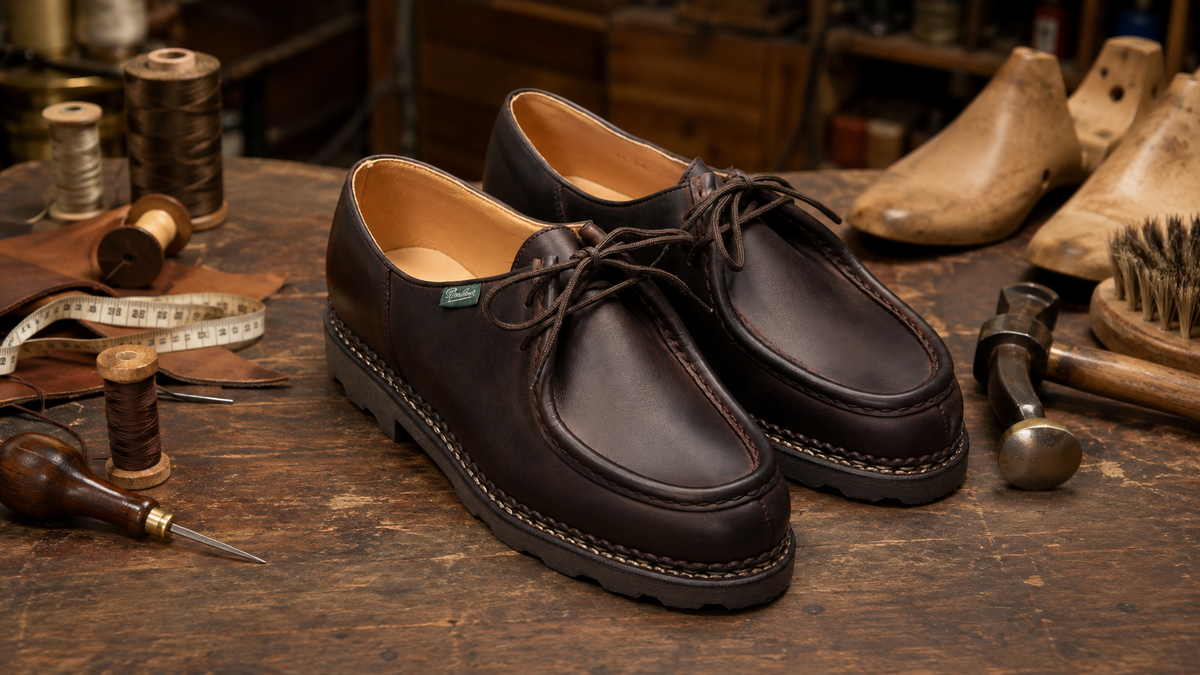
Paraboot: guide to models and how to choose size
Paraboot is one of those choices that seems “just” aesthetic until you wear it for a whole day. Then you understand what you’re really paying for: structure, stability, leather that ages well and a shoe that stands up to time (and outfits) without becoming fragile.
This guide is for anyone considering their first purchase, for those already loyal to the brand but wanting a different model, and for online shoppers who want to minimize sizing mistakes.
 Avoriaz Brown Smooth Bark€ 545,00View product
 Michael Men's Smooth Brown€ 475,00View product
 Michael Men's Nubuck Gringo€ 475,00View product
 Michael Men's Smooth Café€ 475,00View product
 Michael Women's Smooth Brown€ 475,00View product
 Michael Women's Smooth Noir€ 455,00View product
 Michael Women's Smooth Green€ 455,00View product
 Michael Women's Smooth Fauve€ 440,00View product
 Michael Women's Nubuck Gringo€ 475,00View product
 Michel Mouton Women's Brown€ 475,00View product
 Orsay Women's Smooth Brown€ 475,00View product
Products mentioned in the article
Avoriaz Brown Smooth Bark shoesViewMichael Men's Smooth Brown shoesViewMichael Men's Nubuck Gringo shoesViewMichael Men's Smooth Café shoesViewMichael Women's Smooth Brown shoesViewMichael Women's Smooth Noir shoesViewMichael Women's Smooth Green shoesViewMichael Women's Smooth Fauve shoesViewMichael Women's Nubuck Gringo shoesView
 Shoes built to last years, not seasonsThey are resoled, repaired and take shape on your foot. A Paraboot is bought once and kept.See all available models →
Quick summary (read in 60 seconds)
- If you want an all-year Paraboot: look at Chambord or Michael, they are the most versatile pillars.
- If you need cleaner lines and more formality: consider Avignon (sharper line, still robust).
- If you’re looking for a relaxed summer shoe: Barth is the most straightforward option.
- On sizing: in many Paraboot models the fit is generous, often you consider half a size down compared to other shoes (but it depends on foot, socks and insoles).
- Practical method: measure your foot, compare with a “reference” shoe, then do 4 at-home tests within the first 24 hours.
Why Paraboot “wears” and behaves differently
Paraboot was born as a shoe made to last and to walk in. Even when you wear it today in the city or on a trip, many construction choices remain consistent with that idea: more material, more structure, more support.
Two practical consequences (which also affect size):
- Often generous internal volume: many Paraboot shapes have an unconfined forefoot and instep. Great if you walk a lot or have a full foot, less immediate if you’re looking for a “snug” fit.
- Substantial soles: stability is high, but the shoe can feel more “present” on the foot. For some it’s comfort, for others it’s a change of habit.
If you want an official description of the philosophy and constructions, you can start from the brand story on the website Paraboot (useful especially to understand the coherence between models).
Paraboot model guide: real differences, not just aesthetics
Choosing a Paraboot model is not just choosing a different toe. Things change: how volume is distributed, how “stiff” the shoe is on first use, and how easy it is to wear in more formal contexts.
Michael
It’s the model that made Paraboot recognizable even outside the workwear world. The construction and shape have a more “material” imprint: very suitable for those who want a standout but simple shoe.
It makes sense if you walk a lot, want a four-season shoe and like a clean look with noticeable volumes.
Chambord
If Michael is the “tyrolean” icon, Chambord is the derby with an equally strong identity but often easier to wear in smart casual. It’s one of those shoes that works well with both more technical trousers and unstructured tailored pieces.
It makes sense if you want an everyday Paraboot, with a slightly more orderly profile.
Avignon
It remains robust, but tends to be perceived as more “dressy” compared to Michael and Chambord. It’s the typical choice for those who want a less casual Paraboot idea without losing solidity.
It makes sense if you work in settings where the shoe must also look good with a soft suit or cleaner trousers.
Barth
It’s the brand’s summer soul. Lighter in use (not in quality), easier to pack in a suitcase, very natural with travel looks.
It makes sense if you want a spring–summer shoe with a relaxed but premium approach.
Thiers (and the more “linear” derbies)
Paraboot also has more minimal and less voluminous models. They are usually interesting if you want to enter the brand without starting from the most iconic volumes.
It makes sense if you’re looking for a compromise between Paraboot identity and a slimmer silhouette.

How to choose the right model: mini decision tree (real use)
The most reliable shortcut is to start from three questions. Not “do I like it?”, but “where will I actually wear it?”.
1) How much do you walk on a typical day?
If the answer is “a lot”, favor models that feel more stable and have comfortable forefoot volume. Generally Michael and Chambord are strong candidates.
If you walk little but need a neater profile, Avignon and the more linear derbies become more sensible.
2) Is your wardrobe more technical or more tailored?
- If you’re into urban outdoor, travel, clean gorpcore, Michael and Chambord integrate naturally.
- If you’re into office, fine knitwear, more constructed trousers, Avignon often “finishes” the look better.
3) Do you need a shoe that also works in hot weather?
If yes, Barth (and generally the “boat” area) is more coherent than forcing a heavy derby in summer.
Sizes Paraboot: a practical method for choosing well online
The most common question is simple: “Paraboot runs big?”. The honest answer is: often yes, but not always in the same way, because shapes, materials, thicknesses change and also how you intend to use it (thin sock vs thicker technical sock, bare foot vs insole).
Below you’ll find a method that reduces error without relying on “go half a size down” as a universal rule.
Step A: measure the foot in a useful way (not just length)
Measure in the evening (when the foot is more “full”) and use a sheet of paper on the floor.
Note down:
- Length: heel to the longest toe.
- Forefoot width: at the widest point.
- Instep: if you have a high instep, you'll need more volume even at the same length.

Step B: choose a comparable “reference shoe”
Choose a shoe you already own that:
- is leather (or similarly structured),
- has a similar construction (a derby with a substantial sole is better than a soft sneaker),
- is comfortable after a day of wear.
Then compare how it fits you in three areas: forefoot, heel, instep.
Step C: interpret the toe allowance (realistically)
For structured leather shoes, the toe allowance shouldn’t be “running shoe” big. Generally look for:
- enough space to avoid hitting the tip when going downhill or after many hours,
- lateral control to prevent your foot from “floating” (if that happens, it’s often not just length: it’s volume).
If you’re between sizes, the variable that usually decides most is width/volume, not the millimeter of length.
Step D: 4 quick at-home tests (before removing the tags)
Do them on a clean carpet, wearing the socks you'll actually use.
- Heel test: walk 30 steps. The heel should stay stable; a tiny initial movement can happen with new shoes, but it shouldn’t “slap”.
- Flex test: bend your foot as if doing a lunge. The bend should fall where your foot bends, not too far forward.
- Scale test: go up and down. If you feel pressure on the toes when going down, it's a serious sign.
- Instep test: tighten the laces. If you have to tighten until the flaps are completely “closed” to feel stable, the volume is probably too large.
| Check | Good sign | Wrong size/volume sign | What to try before returning |
|---|---|---|---|
| Toe box | toes free, no contact while walking | toe touches or pressure on the toes | thinner sock (only if everything else is perfect) |
| Heel | stable, without marked “pumping” | heel slipping, instability | different lacing, but if it persists you need another size |
| Forefoot | lateral containment, comfort | foot “floating” or lateral compression | consider a different volume, not just length |
| Ankle collar | lace works without fully closing | you need to tighten too much, discomfort on the collar | try a thinner insole, if you already use one |
A note on UK, EU and conversions
Many models Paraboot are listed in sizes UK. Conversion between systems is not always perfect across different brands, because each last has its own tolerances and volumes.
If you’re shopping online and have a specific doubt (wide foot, half size, insoles), the quickest solution is to write with:
- foot length in cm,
- two sizes you usually wear (one sneaker and one leather shoe),
- note about socks and insoles.
Our recommended options (based on use)
Here you’ll find a curated selection to choose with less hesitation. To see what’s available right now, you can start from the collection Paraboot.
Paraboot Michael
Best for: urban everyday, travel, those who walk a lot and want a distinctive shoe.
Key features: structured construction, comfortable volume, sole that provides stability.
What to pair it with: straight or fatigue trousers, clean knitwear, minimal technical outerwear. If you want a sneaker alternative coherent with the same wardrobe, see Flower Mountain.


Paraboot Chambord
Best for: smart casual, informal office, “one good shoe” for much of the year.
Key features: versatile derby profile, presence on the foot without being excessive.
What to pair it with: overshirt, unstructured blazer, wool or compact cotton trousers.
Paraboot Avignon
Best for: for those who want Paraboot but with a neater, more work-ready footprint.
Key features: cleaner line, good transition between relaxed formal and everyday.
What to pair it with: cleaner trousers, coats or jackets with light construction, fine knitwear.
Paraboot Barth
Best for: spring-summer, weekends, travel with an essential look.
Key features: lighter approach, immediate style, nautical mood without excess.
What to pair it with: cropped trousers or clean shorts, lightweight shirts, minimal layering.
Paraboot Thiers (or similar lines)
Best for: for those who want to enter the world of Paraboot with a more linear silhouette.
Key features: more discreet design, a good base for “clean” outfits.
What to pair it with: straight denim, essential chinos, sober workwear jackets.
If instead you need a premium sneaker
Best for: daily rotation, immediate comfort, polished sporty look.
Key features: lighter weight, less break-in, easier maintenance.
What to pair it with: if you want a retro-technical aesthetic, also explore Karhu.
Fit and comfort: what to expect in the first days
A new Paraboot may require a short adjustment period, especially if you come from soft sneakers. It's normal to feel more structure under the foot and a leather that feels “present”.
What should not happen:
- sharp pain (especially on toes or the side of the forefoot),
- an obvious slipping heel,
- pressure on the instep that forces you to loosen the laces.
In these cases, don’t wait 'it will soften': often it’s a matter of volume or size. Remember that on Ski Sises you have returns within 14 days (a useful policy when you’re optimizing size remotely).
Essential care (to make them really last)
Longevity is not just a brand promise; it’s also minimal but regular maintenance.
- Brush: after use, especially if you’ve walked on wet ground or dirt.
- Proper drying: never near direct heat sources.
- Shape: shoe trees when possible help maintain structure.
If you’re preparing for a winter trip and want to optimize what to bring and what to rent, in Biella you’ll also find dedicated services: here’s an overview of the in-store sport service and a practical guide toski rental in Biella.
FAQ
Paraboot fitting large? Fit is often perceived as generous, especially on iconic models. The correct choice depends on foot volume, socks and insoles.
Better Michael or Chambord as a first Paraboot? Michael if you want a more iconic, “textured” look; Chambord if you’re after a more versatile shoe for smart casual and office wear.
Can I use an insole with Paraboot? Yes, but the insole changes the internal volume. If you’re between sizes, stating you’ll use an insole from the start is decisive.
How long does break-in take? It depends on the leather, shape and foot sensitivity. Usually the first uses help determine if it’s just adaptation or a volume error.
If I’m between two sizes what matters most? In most cases volume (width and instep) matters more than length alone. Tests on heel and forefoot help more than any conversion chart.
Closure: the smartest choice is the one consistent with your use
If you want a Paraboot you’ll actually wear, first choose the scenario (city, work, travel, summer), then the model, then the size with a measurable method. When those three points are clear, buying online becomes easy.
To get started, explore the collection Paraboot and, if you are undecided between two sizes, contact us with your foot measurements and a reference shoe: we’ll help you reduce the margin of error before placing your order.
Ski Sises on Google
Choose Ski Sises as a preferred source: you'll see our guides and news more often in Top stories on Google.


