




































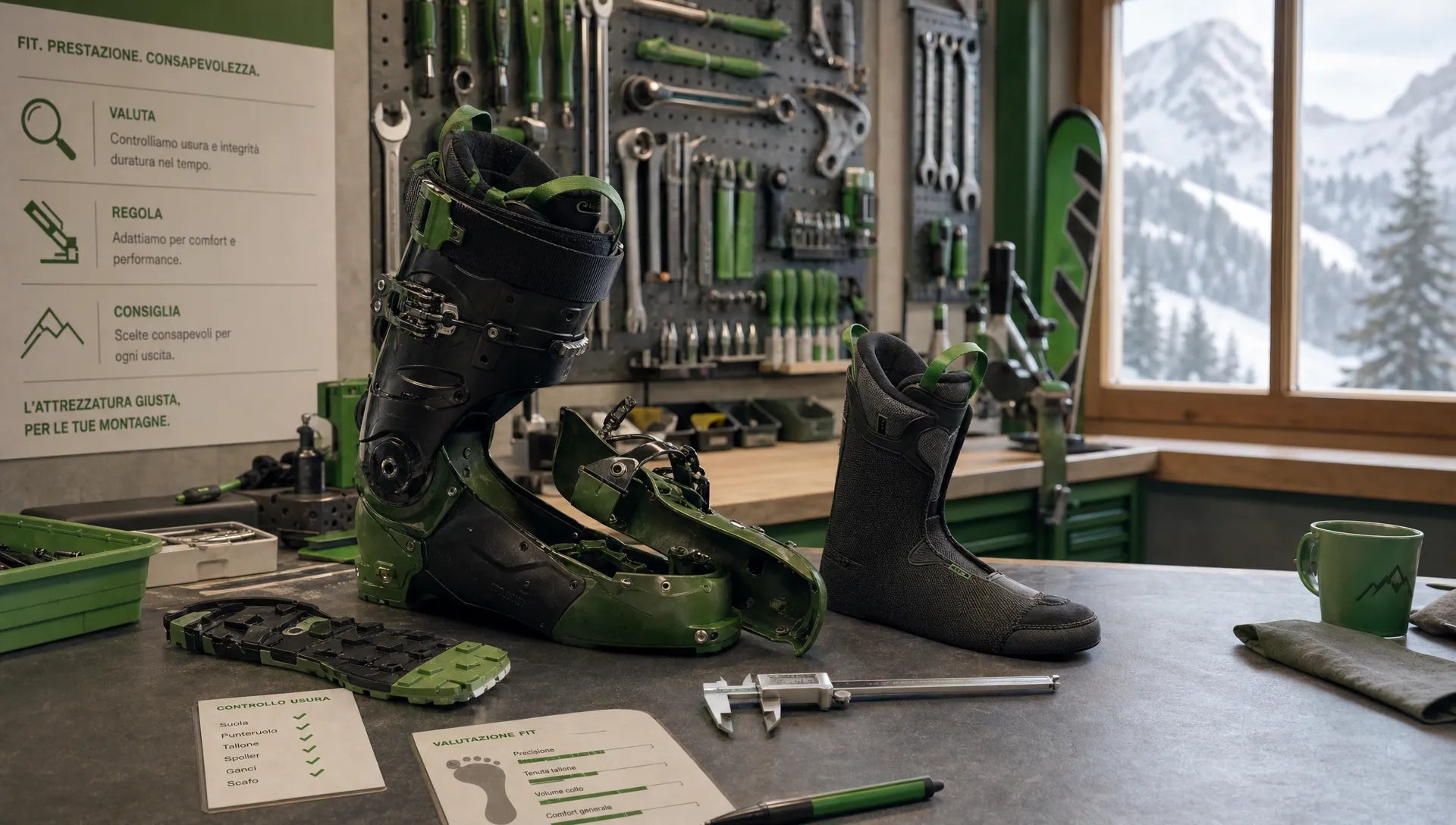
Dynafit Baltoro 2.0: Who Needs Today
The Dynafit Baltoro 2.0 is one of those ski mountaineering boots that today needs to be evaluated with clarity: not as novelty, but as a possible choice for precise use. It can make sense for those looking for a solid, comfortable and classic touring boots, especially if they already own it or find it in good condition. It makes less sense for those who want maximum lightness, freeride pushed or modern performance uphill. This guide serves to understand when choosing it, when avoiding it and how to build a coherent setup around it.
Quick Summary
- Serves to those who make ski mountaineering classic: regular trips, average altitude differences, pragmatic approach to the mountain.
- It is interesting if the fit is correct: a dated but comfortable boot is worth more than a bad new model.
- It should be carefully checked if used: hull, hooks, soles, inserts, shoes and leg mobility.
- It is not the first choice for extreme lightness: Those seeking maximum uphill efficiency should look at more current models.
- It does not replace a pure alpine boot: for intense track and very structured skis, better a more specific solution.
- You should try it with your setup: skis, attacks, socks and plantars change the final feeling a lot.
The point: what type of boot is today the Baltoro 2.0
Baltoro 2.0 should be read as a ski mountaineering boot designed for a traditional balance: enough downhill support, usable walk, construction oriented to the duration. It is not a race product, it is not an ultra-minimalist object and does not arise for pure alpine skiing.
Today the market has moved a lot. The latest touring boots work on lower weights, more shrimp hike, more refined closures and more advanced interfaces. This does not automatically exceed any previous boot. But it makes it more specific: the Dynafit Baltoro 2.0 makes sense if your way of skiing corresponds to its character.
The question is not “is it still valid?” The correct question is: “Is it valid for my foot, my level and my trips? ”.
| Profile of use | Does that make sense? | Why? |
|---|---|---|
| Ski mountaineering classic | Yes | Good compromise for non-extreme climbs and controlled descents. |
| Beginner evolved | Yes, if well stocked | It can be a concrete choice if comfort is high and the state is good. |
| Aggressive Freeride | Only partially | It may not offer the required support from large skis and high speeds. |
| Light and fast touring | Little bit. | The current models are often more efficient uphill. |
| Pista resort all day | No. | Better a specific Alpine boot for transmission and precision. |
| Split softboot | No. | It is a ski product, not from traditional splitboard with snowboard boots. |
Who really needs it?
Baltoro 2.0 serves first of all to the skilful who does not reason to the gram. Those who make half day trips, Sunday trips, itineraries with moderate altitude difference and some descent on variable snow can find it still sensible, provided that the fit is correct.
It is an interesting choice for those who are entering ski mountaineering and want to understand their own style before investing in a latest generation boot. In this case, however, the priority is not the price. It is the safety of the purchase: a boot used with worn soles, marked inserts or shoes now sold can become a false economy.
It can also serve those who already own it and ask if to replace it. If you have no pain, if the closure is stable, if the walk is smooth and if the downward control remains satisfactory, there is no automatic reason to change it. Replacement becomes more logical when you start looking for more uphill mobility, more precision, less weight or more up-to-date compatibility with the rest of the setup.
If you start from scratch and want to stay on a modern setting, it makes sense to compare it with theDynafit selectioncurrent, especially if you are looking for a boot closer to today's needs.


When to avoid it
There are cases where the Dynafit Baltoro 2.0 is not the right choice, although the price seems favorable.
Avoid it if the foot is not stable. The heel that is raised, the fingers tablets, the neck of the sore foot or a marked lateral pressure are not details to “set skiing”. In mountaineering, every little nuisance is amplified by the ascent, cold and hours of use.
Avoid it even if the goal is to make height difference quickly. Today there are more efficient boots for those looking for long pace, frequent transitions and fast approaches. Baltoro 2.0 can accompany a classic trip well, but it is not the reference for those who want a light and very dynamic setup.
Other critical case: freeride and very structured skis. If you use wide skis, go strong, look for progressive support and so much transmission, you may feel the limit of a more touring boots. In that case you should choose a shoe designed to handle more important loads.
Finally, pay attention to the use without possibility of proof or return. The boot is the most personal point of the equipment. A ski can fit multiple profiles. Not a boot.
Checklist before buying it or continuing to use it
Before deciding, evaluate the boot as a technician, not as a deal.
- Scafo: seek cracks, deformations, deep signs or stressed areas near hooks and joints.
- Hooks and levers: they must close cleanly, without games and without abnormal hard points.
- Sisters: verification of consumption, regularity of support and compatibility with the attacks you use.
- Inserts and connection points: Check that there is no obvious wear, games or visible damage.
- Inner shoes: if it is crushed, deformed or very yielding, the fit changes radically.
- Catch: In walking mode it must move smoothly, without noise or strange blocks.
- Real test: wear it with technical stocking, any plantar and trousers you will use on your trip.
If you have any doubts, I'd better check in the store. For those who pass from Biella, the ski and snowboard workshop is the correct place to check equipment status, compatibility and small adjustments before the season.

Fit and size: the part that decides everything
In touring, the wrong size is paid twice: uphill with rubbing and downhill with loss of control. Baltoro 2.0, like any ski mountaineering boots, should be chosen from the foot, not from the usual size of the sneakers.
The fit must lock the heel well without compressing the ampiede. Your fingers can touch in front of you when you're standing, but they have to paint when you're in a ski position. If you have to tighten too much hooks to feel stable, probably the volume is incorrect.
Also beware of the shoe. On a model used, the interior may have formed on the foot of another person. This can create empty areas, strange pressures or an initial feeling of comfort that disappears as soon as you start skiing. In case of doubt, a prolonged trial is more useful than five minutes on foot.
For those who buy online, the criterion is simple: choose only if you already know the Dynafit fit, if you have precise data on your foot or if you can count on a clear return policy. Saving doesn't make up a boot that doesn't work with your body.
How to decide: quick shaft
Use this logic if you are undecided to hold, buy or replace the Baltoro 2.0.
| Question | If the answer is yes | If the answer is no |
|---|---|---|
| Is the boot comfortable after at least 20 minutes? | Continue the evaluation. | Avoid it or bootfitting. |
| Ankle and ankle remain stable? | It can work. | Risks little downward precision. |
| Do classic trips, not races or extreme differences? | It is consistent with use. | Better a more specific model. |
| Is the status of soles, hooks and inserts good? | It makes sense to keep it or buy it. | Do a technical check before using it. |
| Do you want to improve the climb? | Consider modern alternatives. | Baltoro 2.0 can be enough. |
This table does not replace a test, but it helps to avoid the most common error: to buy a boot because “it looks robust”, without wondering if it works well with the foot and with its own way of skiing.
Suggested options
1. Dynafit Baltoro 2.0 in excellent condition
- Ideal for: who does classic mountaineering, already owns the boot or finds a verifiable used.
- Key Features: Solid touring setting, support suitable for controlled descents, pragmatic choice if fit is correct.
- To match with: thin or medium technical stocking, stable plantar, not too extreme touring skis and professional control of attacks.
2. Current Dynafit boot
- Ideal for: who starts from scratch, wants more uphill efficiency or seeks a modern fit without compromise on reliability.
- Key Features: more up-to-date solutions, more attention to the relationship between walking and transmission, more logical choice for long-term purchase.
- To match with: Layered technical clothing, light gloves for transitions and daily compact backpack.
3. Setup touring with technical layers La Sportiva
- Ideal for: who wants to make the whole exit more comfortable, not only change the boot.
- Key Features: garments designed for movement, protection and temperature management during ascent and descent.
- To match with: a well stocked boot, light shell and essential accessories. To build the kit you can start fromtechnical leaders La Sportiva.


4. Try or rent before purchase
- Ideal for: beginners, skiers who fall after years of break or those who do not yet know their style uphill.
- Key Features: reduces the risk of buying an unsuitable boot, allows you to understand what you really need, helps to compare real feelings.
- To match with: advice in store, try with correct stockings and a day on easy ground. If you are in the area, consider the ski and snowboard rental service before buying.
5. Mountain weekend and travel kit
- Ideal for: who organizes short exits, car trips or weekends with more clothing changes.
- Key Features: order, material protection, space for dry layers and accessories.
- To match with: durable bag, clean midlayer and modular shell. To complete the travel part, look at the selectionThe North Face.


FAQ
Is Dynafit Baltoro 2.0 still valid today?Yes, if you use it for classical mountaineering, if it is in good condition and if it fits correctly. It is not the most modern choice for those looking for extreme lightness or maximum uphill efficiency.
Is it okay with a beginner?It can go well for an evolved or very motivated beginner, but only after an accurate test. For those who have no experience, it is often safer to try multiple models or start from the rental.
Can I use it on the track?You can use it for track strokes or light days, if compatible with your setup. However, it is not a pure alpine boot, so it is not the ideal choice for those who ski mainly in resorts with intensity.
What should I check if I buy it?Check hulls, hooks, soles, shoes, leg joints and connection points with the attack. If you notice games, cracks, irregular consumption or little precise closures, better show it to a technician.
Better used Baltoro 2.0 or a new boot?It depends on budget and fit. A Baltoro 2.0 in good condition can be sensible, but a new boot offers more guarantees, unpolluted materials and updated solutions.
Do you need bootfitting?Not always, but often helps. Even small adjustments can improve comfort, control and durability of outputs. If you feel localized pressure or instability, bootfitting is recommended.
Next step
If the Dynafit Baltoro 2.0 corresponds to your way of living the mountain, consider it with technical attention, not only economic. If you want to start with a more current solution, exploreDynafit selectionor switch to Biella store for a targeted tip on fit, attacks and complete setup.
Ski Sises on Google
Choose Ski Sises as a preferred source: you'll see our guides and news more often in Top stories on Google.