Article: Men's hats: how to choose the right model for purpose, season and style
Men's hats: how to choose the right model for purpose, season and style
If you’re looking for men’s hats, the useful question isn’t which model you see most often. What matters is understanding when you’ll actually wear it: daily commute, weekend away, cold strolls, light trekking, running, winter mountain days or simple urban use. From that choice come differences in shape, material and trade-offs. A warm beanie can be ideal in January but too much when you walk briskly. A ventilated cap helps when you sweat but won’t replace a cold‑weather piece. In the selection of hats and accessories at Ski Sises you’ll find very different models: it makes sense to compare them by use, not just by brand or color.


Men’s hats: pick the situation first
The most practical difference is this: a hat can warm, protect from moisture and wind, manage sweat or complete a specific outfit. Sometimes it does two of those things. Rarely does one model excel at all of them.
If you need it for standing around in winter or for many hours outdoors without intense activity, a beanie is the simplest solution. It covers well, fits easily in a pocket or pack and doesn’t need adjustments. If instead you move fast, run or alternate climbs and breaks, a headband or a lightweight technical piece can make more sense — it warms less but is easier to manage when you increase your pace. When light moisture is the main issue, another family of products comes into play: waxed‑cotton hats.
This first filter also avoids repeated purchases. If you already own a heavy city beanie, buying an almost identical one changes little. It often makes more sense to add a model for active use or a light rain hat.
The knit beanie works when warmth matters more than ventilation
The classic knit beanie is the model many people use most from late autumn through winter. It’s great when you’re outdoors for a long time but not constantly exerting yourself: daily trips, walks, travel, standing at the sidelines, mountain spots you reach by car.
Material and bulk matter most here. A model like the Brodeo Black Hat from Patagonia uses a blend with 70% recycled wool and 26% recycled nylon. That gives a fuller feel than a light synthetic and an appearance that’s easy to wear in the city. The trade‑off is simple: if you move a lot or frequently enter heated spaces, it can become too warm.
Products mentioned in the article

If you prefer a more basic build, the collection also includes acrylic models such as the Zeta Black Hat from Montura. The advantage is practicality: easy care, fast drying, little fuss. It makes sense as an everyday hat with low demands or as a spare to keep in your pack. The compromise is that, at the same thickness, the feel and warmth aren’t the same as a richer wool blend.
Products mentioned in the article

If you want a more tactile presence, models like King Jammy Navy hat from Howlin, described as Scottish lambswool, should be read this way: more perceived warmth, more character in your look, less technical neutrality. Before buying, also check the volume. A full beanie can be very appealing visually, but under a hood it takes up more space and packs down less on trips.
Products mentioned in the article

Headband, convertible neck warmer or balaclava: when a full hat is too much or not enough
Covering the whole head isn’t always the best choice. If the problem spots are your ears and forehead exposed to wind, a headband can feel more balanced. It lets out more heat, reduces overheating and is easy to manage when you switch between activity and short breaks.
The Broken Light Black headband from Montura, in stretch polyester, fits exactly that role: an active accessory for movement, not a replacement for a warm beanie in cold, still winter. The advantage is that it covers the sensitive area without weighing you down. The limit is obvious: the top of the head stays more exposed.
Products mentioned in the article

If you want to reduce the number of pieces to carry, a convertible neck warmer can make sense. The Polar Cap Neck Warmer Black from Montura can switch from neck warmer to beanie. It’s useful if temperatures and wind change during the day, or if you want a simple accessory for light trekking and leisure. The compromise is that a convertible product rarely performs as well as two separate pieces: as a beanie it can be less stable than a dedicated model, and as a neck warmer its fit depends heavily on how you adjust it.
Products mentioned in the article
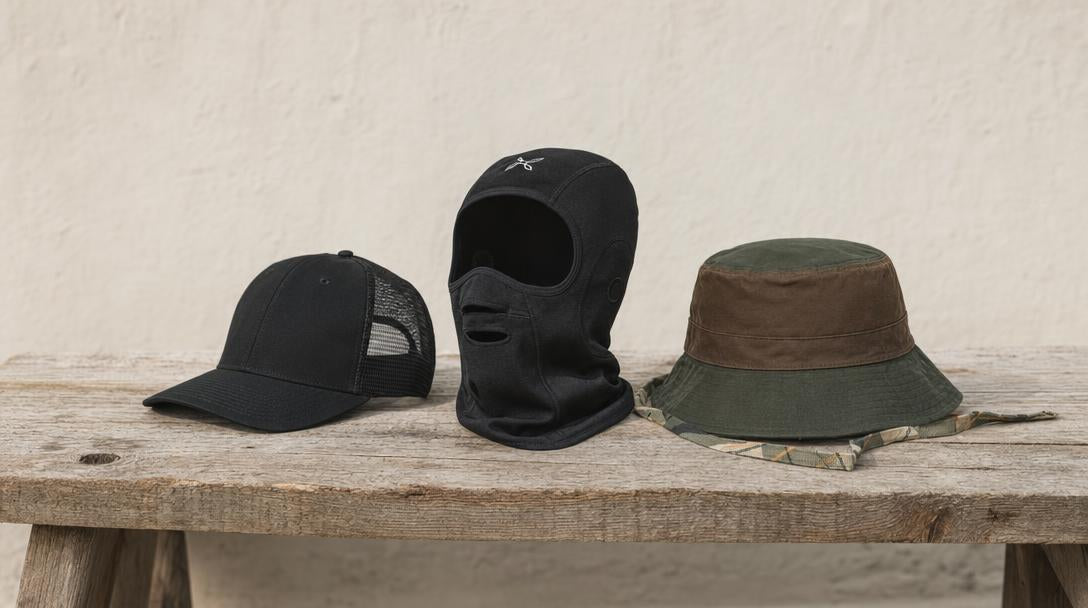
Increasing protection, there’s the Balaclava Light Hat Men Blackwith brushed Thermolite DWR nylon on the reverse, openings for eyes, nose and mouth and mesh side vents at the ears. The intended use is clear from the specs: alpinism and various outdoor activities. For city use, errands or casual wear it would simply be too specialized.
Bucket and waxed hats: useful if you often face light rain and have a coherent wardrobe
Among men’s hats there’s another family different from winter beanies and lightweight caps: brimmed hats. These often combine light protection from the elements with style. If you already wear waxed jackets or heritage outdoor pieces, a waxed cotton hat can be coherent. If you want a single accessory to use in every situation, it usually isn’t the most versatile starting point.
The Sporthut Waw Men Sage hat from Barbour is waxed cotton with a tartan lining. A model like this makes sense when you want practical protection from damp, wind and light rain without switching to a technical hood. It can work well on weekends, in damp transitional seasons and with classic-cut jackets. The limits are two: it warms less than a winter beanie and requires a fairly coherent aesthetic. On very sporty or very minimal clothing it can seem out of place.
Even more characterful is the Brackley Wax Fern/Beech hatA waxed-cotton wide-brim bucket with rope trim, cotton lining and tartan details. The care instructions say it’s suited to light rain and damp conditions, and to clean it with a damp sponge — no hand washing or machine washing. That’s important: the fabric needs specific care. In return you get a hat with a clear purpose. It isn’t a technical mountain model, nor is it the easiest piece to stuff into a backpack without thinking.
If you want to understand when wax really helps versus plain cotton, the following article can be useful Barbour wax: when it makes sense to choose a waxed jacketThe material and maintenance logic is similar.
Trucker and lightweight caps: better when ventilation matters, not warmth
Not every men’s hat is meant to keep you warm. A visor cap or a trucker makes more sense when the issue is sun, light or comfort during light activity. They’re more suitable in shoulder seasons, while traveling and on days when a beanie would be too much.
The P-6 Logo Lopro Trucker Black hat The Patagonia model pairs an organic-cotton front, a recycled-polyester mesh back, a NetPlus® visor made from 100% recycled fishing nets and an adjustable snap closure. The practical benefit is obvious: more ventilation and a more adaptable fit. The limitation is equally clear: in cold wind the mesh lets air through, so it does not replace a winter hat.
If your use is even more movement-focused, the Aereoready White hat from Adidas is designed to breathe, with a mesh lining and an adjustable rear closure. The spec also notes it’s made in part with Parley Ocean Plastic and contains at least 70% recycled materials overall. It’s sensible for light runs, warm-ups, brisk walks or outdoor activity in mild conditions. The question to ask before buying is concrete: do you need it to manage sweat and light, or to protect against cold? If it’s the latter, you’re in the wrong category.
Materials change a hat’s behavior more than the logo does
When you compare men’s hats, material shouldn’t be read as an absolute ranking. Read it relative to what you’ll use it for.
Wool and wool blends often make sense in dry cold, for everyday use and for long stops, because they give a fuller sense of warmth. In the collection that approach appears in the Patagonia Brodeo and in the beanies from Howlin. The personal check to run is simple: if certain yarns irritate your forehead or you want something very easy to wash and dry, this may not be the most practical route for you.
Acrylic is easier to manage and often a more straightforward purchase. It works well if you want a hat to use without much fuss or a model to rotate frequently. In exchange, anyone seeking a richer hand or more natural cold behavior may prefer other fibers.
Fleeces and technical fabrics come into play when lightness, quick drying and activity matter. The official Montura page for the Rewind Fleece describes an accessory you can wear as either a beanie or a neck warmer and lists a POLARTEC High Loft fabric with thermoregulating properties, low weight and good insulating power. That’s useful context for reading this category: accessories designed to move with you and adapt, not just to add warmth.
Waxed cotton doesn’t replace every other material. It’s useful when the environment is damp, your clothing leans that way and you accept different care. If you want zero fuss and something you can toss in your pack after every use, it’s probably not the most straightforward choice.
Three concrete checks before buying
- Check how long you’ll keep it on without taking it off. Two hours standing in the cold and twenty minutes of fast walking call for different hats.
- Decide whether it must work with a hood or helmet. A bulky beanie can be uncomfortable; a headband or a thinner model fits better into layering.
- Read the care instructions before checkout. A waxed cotton hat isn’t treated like acrylic, and a lightweight technical model only makes sense if you’ll really use it in motion.
A simple rule: if you want a single piece to wear often between city life and cold weekends, start with a well chosen knit beanie. If that role is already covered, add a more specific model only when it solves a real need. If you want to compare shapes, materials and uses at your leisure, you can explore the Accessory Hats collection.
FAQ
Is a beanie or a headband better if I move quickly but my ears get cold?
If the main discomfort is at the ears and forehead, a headband is often more balanced than a full beanie. It covers the area most exposed to wind but lets more heat escape from the top of the head, so you tend to overheat less as your pace increases. A beanie is still better if you stay still for long periods, if it’s very cold or if you want full coverage. The most useful test is simple: after ten to fifteen minutes of walking, do you tend to take your hat off? If so, a headband may be the more consistent choice.
Is a waxed cotton hat enough when it rains?
It can make sense in light rain, humid air and everyday outdoor use, but don’t confuse it with a technical waterproof accessory. Waxed cotton works well when you want practical protection and a style that matches classic jackets or outdoor heritage. The limit comes with heavy rain, prolonged sporting activity or highly variable conditions. Before choosing, check both the product sheet and the care required: this category needs more attention than a knit beanie.
Which men’s hat makes most sense if I sweat easily?
If you sweat easily, don’t assume a thick beanie is the universal answer. Depending on the season, a technical headband, a convertible neck gaiter, or a lightweight breathable cap often makes more sense. A headband reduces heat buildup, a convertible piece gives you flexibility to adapt during the day, and a mesh-cap performs better in mild weather or low-intensity activity. Ask yourself: do you really need extra warmth, or do you need to manage moisture and comfort while you move?
How many men’s hats do you really need to cover different uses without buying duplicates?
For most people, two well-chosen hats are enough. One should be a daily cold-weather beanie for city use, weekends and normal winters. The second should be more specific: a headband or technical cap for activities, or a waxed hat if you spend long periods outdoors in light rain while wearing classic clothing. A third item only makes sense if it fills a real gap in your current wardrobe.
How can I tell if a hat will sit comfortably under a hood or helmet?
Volume is the main factor. A thick beanie or one with lots of bulk on top can bunch at the back of the head, press the forehead or shift under a snug hood. Thin headbands and low-profile designs usually layer better. If you plan to use it under a helmet or hood, don’t judge it only from the front photo: check how full the construction is, whether it has a large cuff and how much room it leaves on top. The more compact the hat, the likelier it will work in layers.
How do you clean a waxed-cotton hat without damaging it?
A waxed-cotton hat shouldn’t be treated like ordinary fabric. When the product notes recommend it, clean with a damp sponge and avoid hand-washing or machine-washing. That helps preserve the wax finish, which is the functional part of the garment. Always check the specific product instructions before you act: maintenance affects both appearance and lifespan.
Ski Sises on Google
Choose Ski Sises as a preferred source: you'll see our guides and news more often in Top stories on Google.